The people of Sri Lanka get about 40 percent of their calories from rice. Though rice is the most important crop in Sri Lanka, the per-capita consumption of imported wheat is increasing.
[Photograph by Tim Page. Corbis. Reproduced by permission.]
China, India, and Africa, and at the present time it is used as a principal food throughout the world. After the discovery of the Americas, the use of rice took hold in both continents. The national dish of Belize in Central America, for example, is composed of rice and beans. There are now hundreds of rice recipes, with each ethnic cuisine having developed individual recipes. Almost all cookbooks have rice recipes, including recipes for risottos and pilafs. Vegetarians, in particular, cherish rice because it is such an excellent food and can be prepared in so many different and appetizing ways. Rice, delicious in itself, readily takes on any flavor that is added. Long-grain rice, when cooked, becomes separate and fluffy, while medium-grain rice is somewhat chewier. Short-grain rice tends to clump together and remains sticky with its starchy sauce. Arborio is an example of a short-grained rice. Wehani rice has a nutty flavor. Basmati rice (aromatic) is very popular, as is jasmine rice.
Rice is the only subsistence crop grown in soil that is poorly drained. It also requires no nitrogen fertilizer because soil microbes in the rice roots fix nitrogen and promote rice growth. Rice adapts itself to both wetlands and dry soil conditions.
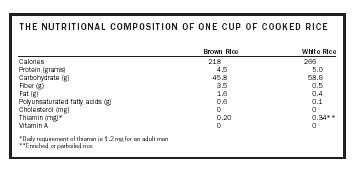
Rice is a high-carbohydrate food with 85percent of the energy from carbohydrate, 7 percent from fat , and 8 percent from protein . However, rice also has a considerable amount of protein, with an excellent spectrum of amino acids . The protein quality of rice (66%) is higher than that of whole wheat (53%) or corn (49%). Of the small amount of fat in brown rice, much is polyunsaturated . White rice is extremely low in fat content.
A cup of cooked rice has approximately 5 grams of protein, which is sufficient for growth and maintenance, provided that a person receives adequate calories to maintain body weight or to increase it, if full growth has not yet occurred. Asiatic children for whom rice is the chief food source have not developed protein deficiency disorders such as kwashiorkor , as have infants
that are fed corn or cassava as a chief staple after weaning. Growth and development are normal on a rice diet . Due to its easy digestibility, rice is a good transition food after the cessation of breast or formula feeding.
Dutch physicians in Java and Japanese physicians particularly noted the occurrence of beriberi with edema , heart failure, neuropathy , and many deaths. Thiamine, of course, was an unknown substance at that time. The history of rice is of interest in illustrating how the technology to make a food more appetizing (i.e., white rice versus brown rice) led to an epidemic of a new disease for those populations whose food intake was largely based upon rice. Studies by physicians in Japan and in Indonesia led to a cure for beriberi that included a more varied diet, plus the use of rice husks and the outer coatings of rice, which contained thiamine.
Today, much of the rice consumed is either enriched with thiamine or parboiled, which leads to retention of thiamine in the matrix of the white rice kernel. Beriberi, as a disease from the consumption of white rice, is now rare if the rice is parboiled or enriched. However, some varieties of polished (white) rice may not be enriched with thiamine. Thus, when thiamine intake from other food sources is limited, thiamine deficiency could still occur. In the United States, thiamine deficiency typically occurs in chronic alcoholics.
Rice has been the mainstay of treatment for a number of conditions, particularly for hypertension at a time when few effective drug therapies were available. In the 1940s, Walter Kempner developed a treatment for mild, and even malignant , hypertension at Duke University. His hypothesis was that a low-protein diet, free of salt, would be an effective treatment. He devised the "rice diet," which consisted of rice, fruits, and vegetables. This treatment had good results: the blood pressure of his patients fell, and even malignant hypertension was partially reversed. In addition, blood cholesterol levels also fell. Since this was a cholesterol-free and low-fat diet, it was one of the first to document a cholesterol-lowering effect from diet.
The other therapeutic role of rice is in the treatment of allergies . Rice seems to be nonallergenic, and rice milk has been fed to infants allergic to cow's milk. Rice proteins have also been incorporated into standard infant formulas.
"Golden rice" was genetically engineered to contain beta-carotene, not present in standard rice, to combat the widespread vitamin A deficiency and ensuing blindness in the children of the developing world. Beta-carotene is a vitamin A precursor that is converted to the vitamin by enzymes of the intestinal mucosa . Vitamin A, or retinol, is then absorbed and transported to the tissues, including the structures of the eye. Golden rice would thus seem to be an advance in the fight against vitamin A deficiency in rice-eating populations. However, there are some concerns about golden rice and other genetically engineered foods. Genetically engineered products have not necessarily been proven safe, and environmental or social risks may outweigh potential benefits that they may bring about.
Clinical trials of golden rice are needed before it is accepted universally. only when it is clearly determined that it can prevent vitamin A deficiency in experimental animals, and that it presents no hazards, will this genetically engineered food be considered safe for use in human nutrition. Further, society itself must also decide if genetically created foods are acceptable, a point currently in dispute.
Since the 1960s, the "green revolution" has improved the yield of rice, and now the "green genome revolution" may bring about further improvements. The rice genome has now been sequenced, an achievement of great importance. The sequence of the rice genome will provide the template for the sequencing of other grasses (maize, barley, wheat, etc.). The genome sequences are now known for the japonica rice favored in Japan and other countries with a temperate climate, and for the indica subspecies of rice grown in China and most other parts of Asia. This knowledge will permit a future harnessing of genes for disease prevention, drought resistance, nutritional improvement, and many other possible modifiable features of rice. As a recent issue of Science suggested, a "green gene revolution" is needed to meet the challenge of "population growth, loss of arable land and climate changes."
In summary, rice is an inexpensive, easily prepared, and delicious food. It is also a very nutritious food that benefits humans all over the world.
William E. Connor
Sonja L. Connor
Sea rice use.
Sea (Indian) rice
What disease cures Maritime Indian rice?
The curative properties of this sea of rice are amazing. There is ample evidence that he is able to cure many diseases.
No wonder the organism is called a "living medicine": he actively takes the salt and slag from the body, stimulates metabolism, restores heart function after heart attack and stroke, relieves inflammation in internal organs. Breeding of Indian rice is available to everyone: care of them does not require much time, energy and material costs.
Full list of diseases which are cured with the sea of Indian rice
Common diseases
* Excess weight.
* Metabolic disorders.
* Chronic fatigue syndrome.
* Headache.
* Meteosensitivity.
Diseases of the central and autonomic nervous systems
* Asthenia.
* Insomnia.
* Hyperkinetic syndrome of childhood.
* Depressive disorders.
* Cerebral palsy.
* Neurasthenia.
*
NeurosisNeurosis-like state.
* Stuttering.
* Swoon.
* Consequences of ischemic stroke and transient disorders of cerebral circulation.
* Postkontuzionny syndrome.
* Psycho syndrome.
* Psychopathic states.
* Tiki organic origin in neurological diseases.
* Epilepsy.
* Epileptic syndrome of residual-organic genesis.
Diseases of the immune system
* Beriberi.
* Autoimmune diseases.
* Vasculitis.
* Glomerulonephritis.
* Influenza.
* Diphtheria.
* Immunocomplex disease.
*
Multiple sclerosisMultiple sclerosis.
* Rheumatoid arthritis.
* Systemic lupus erythematosus.
* Furunculosis.
* Suppuration.
Cardiovascular and lymphatic systems
* Arrhythmia.
* Atherosclerosis.
* Varicose veins.
* Inflammation of the superficial and deep venous system.
* Hypertension.
* Stroke.
* Myocardial infarction.
* Ischemia.
* Kardiodistrofiya.
* Cardiomyopathy.
* Lymphadenitis.
* Limfadenoz.
* Lymph edema.
* Violations of the rheological properties of blood.
* Neurocirculatory (vegetovascular) dystonia.
* Postgemmoragicheskaya anemia.
* Posttrombozny syndrome.
* Angina pectoris in traumatic damage to the heart and blood vessels (thrombosis contusion).
* Tachycardia.
* Transmural myocardial infarction.
* Thrombophlebitis.
Diseases of the respiratory system
* Asbestos.
* Asthma.
* Bronchitis.
* Bronhoadenit.
* Sinusitis.
* Pleurisy.
* Pneumonia.
* Colds (ARI).
* Tonsillitis.
* Tuberculosis.
* Pharyngitis.
Diseases of the gastrointestinal tract
* Hemorrhoids.
* Duodenitis.
* Constipation.
* Heartburn.
* Colitis.
* Flatulence.
* Metabolic disorders.
* Violation of peristalsis.
* Pancreatitis.
* Vomiting.
* Diabetes mellitus in mild and moderate form.
* Cholecystitis.
* Cholangitis.
* Chronic active hepatitis (including those caused by viruses B and C).
* Chronic gastritis.
* Cirrhosis.
* Stomach ulcer.
* Duodenal ulcer.
Diseases of the genitourinary system
* Adnexitis.
* Restoration and improvement of potency.
* Ovarian cyst.
* Compensation for renal failure.
* Jade.
* Nephrosis.
* Nephropathy.
* Pyelonephritis.
* Pregidronefroz.
* Prostatitis.
* Enuresis.
* Thrush.
Neoplasms (tumors)
* Benign tumors of the brain.
* Malignant education stomach and food water.
* Lymphogranulomatosis.
* Increase the thyroid gland.
Dentistry
* Periodontal disease.
* Stomatitis.
Diseases of the musculoskeletal
* Arthritis.
* Osteochondrosis.
* Polyarthritis.
* Rheumatism.
Traumatology
* Concussion (post-traumatic rehabilitation).
In addition, marine rice reduces fatigue, restores metabolism, rejuvenates the cells of the body, improves mood, improves performance, reduces weight, wins pathogenic microbes, replacing antibiotics for upper respiratory tract diseases, lowers blood sugar, inhibits the growth of cancerous cells, clears mucous membrane of the gastrointestinal tract, removes plaque with purulent skin diseases, lowers blood pressure, cleans the vessels; eliminates the headaches of nervous origin; normalizes the acidity of the stomach, restores and strengthens the nervous system dissolves salts in the joints, dissolves the sand and stones in the gallbladder and kidney, has analgesic effect, a beneficial effect at radiculitis, helps with insomnia, restoring normal sleep, restores and strengthens the "male power" (the potency), has a diuretic effect, eliminates the common cold, relieves weakness in the legs.
This probably should add that fantastic, at first glance, the effectiveness of marine Rice reaffirmed the centuries-old practice of its application, clinical and laboratory medical research.
Apply this "healing rice with lupus and multiple sclerosis. Treats tincture of this fungus and a whole bunch of endocrine diseases.
Indian rice compared with their "family" - Kombucha and Tibetan - is the most salubrious.
Infusion of Indian rice - an indispensable means of arthritis, osteoporosis, sciatica.
Note the wide range of therapeutic effects and extremely high efficiency of extracts obtained using the sea of rice. This means that the marine rice as a natural remedy, can replace large quantities of synthetic drugs and pharmaceuticals, which sometimes cause enormous damage to our health, polluting the human body.
Clinical and Laboratory investigations have established that infusion of the sea of rice is completely harmless to human body, which is especially important to know when to make a choice, than to be treated: "living medicine or synthetic pharmaceuticals or a combination of both.
Shingles
Attach to the affected area undiluted Indian rice (poured straight from the bottle) 4 times a day and 3 times at night (if you wake up). A few minutes after application of the Indian rice itching and burning sensation of the skin disappear. With this treatment blisters heal quickly.
Night sweats
Night sweats can be prevented by wiping the body extract of Indian rice before bedtime.
Burns
Treatment of burned skin undiluted tincture of Indian rice relieves burning pain and a painful sensation.
Varicose veins
This traditional medicine of many countries, such as Scotland and Germany. Infusion of Indian rice poured from the bottle and rubbed area of varicose veins night and morning. About a month will be observed compression of varicose veins. Along with rubbing twice a day to drink half a cup of infusions of Indian rice.
Skin rash (impetigo)
Impetigo - a staphylococcal or streptococcal infection of the skin. A person exposed to the disease at any age, but especially the children are predisposed to it. If a person who has had this disease, the patient touches the skin with his hands, he always will be infected. When an accurate treatment of affected skin of impetigo can be cured in two weeks.
Finger dip in undiluted tincture of Indian rice, and is applied to the lesions on the skin 6 times a day. This impetigo disappear after 2 - 4 days.
Ringworm (trichophytosis)
Fungal disease of the skin, hair and nails. Superficial lesion smooth skin looks severely limited, round, slightly swollen spots, in which, in most cases we can distinguish two zones: the peripheral spotty-Bubble korochkovy roller and peeling center. Most often they appear on the back and in any place of the hairy body.
Method of treatment: apposition undiluted extracts of Indian rice to the affected area 6 times a day. Indian rice - excellent antiseptic.
Weakness or chronic fatigue
Taking on the night of 2 hours spoon of Indian rice, 30 minutes later you fall asleep soundly. If this is not enough, once again drink 2 tsp, but if you wake up at night - again.
It is advisable to make rubbing hands divorced Indian rice. At half a cup of warm water, add 1 tbsp. spoonful of Indian rice. Pour in the palm of the cup about 1 teaspoons of the solution. First, rub this solution one arm and shoulder and then gradually the same amount of solution chest, abdomen, back, thighs, legs and finally feet. Towel not required. Instead, rub the surface well with both hands to complete absorption of the solution, and it is absorbed very quickly.
Chronic headache
Certain types of severe chronic headache doctors regard as migraine. Active or classic symptoms, however, quite specific. Before the headache begins, a man has to have some preliminary symptoms. This spot or a flash of light before his eyes. It hurts one side of the head - migraine word meaning "half head" - is often observed nausea and other digestive disorders.
Increase your daily intake of acid, using Indian rice, which gives a positive effect.
Traditional medicine considers the effectiveness of another way of using Indian rice in the treatment of migraine. This - a poultice (steam bath). Put the pan into the fire with an equal quantity of Indian rice or water and allow the water to slow boil. When its surface begins to steam up, tilt his head over the basin and hold until the pair will be more or less strong. Inhale 75 times. Usually after this headache stops. If it reappears, it will be about twice as less. Such steam bath can be replaced headache tablets.
High blood pressure (hypertension)
Hypertension - one of the most serious medical problems. This is a fairly common phenomenon, and at the same time very serious condition of the body. There is almost a certain relationship between high blood pressure, and human adaptability to the environment.
It is recommended to increase the daily consumption of acid in the organic form, such as apples. Every necessary to keep the number of fruit, equivalent to four glasses of juice. They can eat at any time convenient for you. If you are using Indian rice, drink it in 2 cups per day.
Dizziness
Prerequisite of vertigo is alkaline urine. When the reaction is changed to acid, dizziness diminishes or disappears altogether. In order to prevent dizziness traditional medicine employs treatment with the help of Indian rice, dosage and duration of admission are the same as used in the treatment of other ailments.
But do not think that if you accept the infusion of Indian rice once or twice, then tomorrow and in the future will get rid of dizziness. Some reduction of vertigo you will be observed by the end of the second week (if you're just going to comply with the requirements of traditional medicine on the admission of Indian rice) and a further improvement by the end of the month.
Sore throat (tonsillitis)
Most common in folk medicine for treating sore throat - gargling infusion of Indian rice. We recommend rinsing after each hour, while gaining a mouthful of the solution, rinse and swallow solution.
Traditional medicine believes that by swallowing solution washes the back of the throat, to which he does not come rinsing. As the reduction in pain interval between rinsing can be increased up to 2 hours
Thus, streptococcal sore throat can be cured for 24 h. on occasion, the patient's symptoms disappeared during the period while he awaited the outcome of the analysis of the microflora in the smear of the throat for the presence of streptococci.
The attack on tonsils disappear within 12 hours
Internal application
Atherosclerosis. Hypertension. Headaches. Appear in people over 35 - 40 years.
Recipes:
* Hypertension drink brew of rice, 200 g 3 times daily after meals;
* With severe headache moisten the towel infusion, put it on the head, lie down. The room should be well ventilated;
* Helps relieve fatigue, warm bath with extract. At a bath of warm water to pour 3 liters infusion.
Metabolic disorders. Diabetes
Regular intake of infusions of rice helps lower blood sugar.
To reduce weight, you have to brew for at least 1 - 1.5 liters per day.
Neurologically
Recipe:
* Recommended to drink the infusion of 150 ml 3 times a day for 1.5 months.
You can drink and longer - there is no side effects!
Gastrointestinal disease (heartburn, gastritis, gastric ulcer, colitis, diarrhea)
Recipes:
* The treatment of diseases of the stomach to use inside the rice infusion of 200 ml (children from 10 - 20 ml) 3 times a day for 1 hour before meals;
* For use inside the infusion of dysentery 7 - 8-day prescription of 100 ml (for children 10 - 20 ml) 3 times daily for 1 hour before eating and then lying on her right side for an hour.
External application of extracts of Indian Maritime rice
Infusion of Indian rice treat various diseases.
Radiculitis him to drink and lubricate the "back of the" spine, lower back, pelvis along the sciatic nerve, with insomnia - clean your ears, with weakness in the legs - lubricate the feet and popliteal notches 1 time per day, with a cold - wash your nose.
Indigestion
If you wake up in the morning from diarrhea and vomiting, you should try to organize the work of the stomach and intestines, take the Indian rice, diluted with water during the day. At dinner to eat some easily digestible food. Within two or three days you should drink a glass of the mixture for each meal to regulate the digestive tract.
Arthritis. Lumbago
Recipes:
* With arthritis can make compresses with a slightly warmed infusion for patients with joints;
* At radiculitis mix a small amount of extracts from raw egg white and rub the painful areas. Half an hour later wipe wet cotton swab.
A positive result is obtained, subject to the instructions.
The therapeutic effect of Indian rice with milk
One of the most important of his abilities - is the ability to clean and smooth the allergic diseases.
The use of sour milk, this mysterious stranger, not only facilitates cardiovascular disease, but cure them. Drink this mushroom kefirchik under increased pressure - means a cure for 2 - 3 years of pretty serious hypertension.
Such an infusion of great help in atherosclerosis - stops chalking the walls of capillaries, treats diseases of liver and gall bladder, dissolves gallstones, treats stomach ulcers and 12 duodenal ulcer. After a severe illness from taking antibiotics, it is desirable to use the mushroom kefir right away, because he not only strenuously antibiotics displays from the body, but also protects the intestinal flora of the death of beneficial bacteria.
Standing reception mushroom yogurt helps maintain the state of vigor and efficiency. It certainly contributes to the rejuvenation of the body. Usefulness of the infusion, and at any inflammatory disease of the oral cavity.
There are many scientific, historical research on this subject, which confirm the healing properties of rice.
Keep in mind that the Indian marine rice is not a panacea, and in each case it is desirable to consult with their physician, as well as to receive infusions of Indian sea of rice may be contraindications.


 Các chuyên mục


![The people of Sri Lanka get about 40 percent of their calories from rice. Though rice is the most important crop in Sri Lanka, the per-capita consumption of imported wheat is increasing. [Photograph by Tim Page. Corbis. Reproduced by permission.]](http://www.faqs.org/nutrition/images/nwaz_02_img0206.jpg)