By E. Goddard Jorgensen
Unusual interest is being displayed in ballooning, and as it is fast becoming the favorite sport many persons would like to know how to construct a miniature balloon for making experiments. The following table will give the size, as well as the capacity and lifting power of pilot balloons:
Diameter. Cap. in Cu. Ft Lifting Power.
24 lb.
5 ft. | 65 | 4 lb. |
6 ft. | 113 | 7 lb. |
7 ft. | 179 | 11 lb. |
8 ft. | 268 | 17 lb. |
9 ft. | 381 |
10 ft | 523 | 33 lb. |
11 ft. | 697 | 44 lb. |
12 ft. | 905 | 57 lb. |
The material must be cut in suitable shaped gores or segments. In this article we shall confine ourselves to a 10-ft. balloon. If the balloon is 10 ft. in diameter, then the circumference will be approximately 3-1/7 times the diameter, or 31 ft. 5 in. We now take one-half this length to make the length of the gore, which is 15 ft. 7-1/2 in. Get a piece of paper 15 ft. 7-1/2 in. long and 3 ft. wide from which to cut a pattern, Fig. 1. A line, AB, is drawn lengthwise and exactly in the middle of the paper, and a line, CD, is drawn at right angles to AB and in the middle of the paper lengthways. The intersecting point of AB and CD is used for a center to ascribe a circle whose diameter is the same as the width of the paper, or 3 ft. Divide one-quarter of the circle into 10 equal parts and also divide one-half of the line AB in 10 equal parts. Perpendicular lines are drawn parallel with the line CD intersecting the division points made on the one-half line AB. Horizontal and parallel lines with AB are drawn intersecting the division points made on the one-quarter circle and intersecting the perpendicular line drawn parallel with CD. A line is now drawn from B to E and from E to F, and so on, until all the intersecting lines are touched and the point C is reached. This will form the proper curve to cut the pattern. The paper is now folded on the line AB and then on the line CD, keeping the marked part on the outside. The pattern is now cut, cutting all four quarters at the same time, on the curved line from B to C. When the paper is unfolded you will have a pattern as shown in Fig. 2. This pattern is used to mark the cloth, and after marked is cut the same shape and size. 
Ill: Pattern for Cutting the Segments
The cloth segments are sewed together, using a fine needle and No. 70 thread, making a double seam as shown in Fig. 3. When all seams are completed you will have a bag the shape shown in Fig. 4. A small portion of one end or a seam must be left open for inflating. A small tube made from the cloth and sewed into one end will make a better place for inflating and to tie up tightly.
It is now necessary to varnish the bag in order to make it retain the gas. Procure 1 gal. of the very best heavy body, boiled linseed oil and immerse the bag in it. The surplus oil is squeezed out by running the bag through an ordinary clothes wringer several times. The bag is now placed in the sun for a thorough drying. Put the remaining oil in a kettle with 1/8 lb. of beeswax and boil well together. This solution is afterward diluted with turpentine so it will work well. When the bag is dry apply this mixture by rubbing it on the bag with a piece of flannel. Repeat this operation four times, being sure of a thorough drying in the sun each time. For indoor coating and drying use a small amount of plumbic oxide. This will dry rapidly in the shade and will not make the oil hard. 
Ill: Sewing Segments Together
Fill the bag with air by using a pair of bellows and leave it over night. This test will show if the bag is airtight. If it is not tight then the bag needs another rubbing. The next operation is to fill the bag with gas.
Hydrogen gas is made from iron and sulphuric acid. The amounts necessary for a 10ft. balloon are 125 lb. of iron borings and 125 lb. of sulphuric acid. 1 lb. of iron, 1 lb. of sulphuric acid and 4 lb. of water will make 4 cu. ft. of gas in one hour. Secure two empty barrels of about 52 gal. capacity and connect them, as shown in Fig. 5, with 3/4-in. pipe. In the barrel, A, place the iron borings and fill one-half full of clear water. Fill the other barrel, B, with water 2 in. above the level of the water in barrel A. This is to give a water pressure head against foaming when the generator is in action. About 15 lb. of lime should be well mixed with the water in the barrel B. All joints must be sealed with plaster of Paris. Pour in one-half of the acid into the barrel, A, with the iron borings. The barrels are kept tight while the generation is going on with the exception of the outlet, C, to the bag. When the action is stopped in the generator barrel, 
Ill: FIG. 5 - The Hydrogen Generator
A, let the solution run out and fill again as before with water and acid on the iron borings. The outlet, C, should be always connected with the bag while the generator is in action. The 3/4-in. pipe extending down into the cooling tank, B, should not enter into the water over 8 in. When filled with gas the balloon is ready for a flight at the will of the operator.
What's a solar balloon?
A solar balloon is a hot air balloon that is heated entirely by the sun. No flame or other external heat source is needed - the balloon gets its heat from the black material which it is made from. Dark colors absorb heat, so the black surface of a solar balloon absorbs heat from the sun, which heats the air inside the balloon. Thus, they can fly all day, without re-heating or re-inflating, as long as the sun is out.
 Solar UFO, see video here.
Solar balloons don't get as hot as fire-heated hot air balloons, but they can be, as some are, made large enough to lift a human plus ballast. This site, however, focuses on smaller-scale balloons - ones that can be made from black trash bags and tape. A simple, 5-foot tall balloon can be made with only four trash bags. When released, it can fly over 500 miles in one day!
Now Available
 This eBook is packed with information on solar balloons. Learn all about how they work, how to get the right materials, and how to make many different balloons.
Included in this eBook are instructions that will teach you in detail how to build many different balloons, including the full fleet of tetroons from 5 to 13 feet and beyond, the EZ Tubes, the standard-shaped balloon, regular tubes, and even the Solar UFO!
Learn about the best weather conditions and times of year to fly, how to fly your own balloon hundreds of miles, how to take aerial photography, and much more. Many questions you may ask are all answered in this eBook.
Click Here for more information. Solar balloon returns
List of solar balloons I released, with "if found" tags, that were found after landing. Arranged in order by total distance traveled.
10-foot tetroon broke 700!
 November 2007
I'm a little late in getting the word out, but now the video is done and I am announcing my longest flight yet...A 10-foot tetroon flew 780 miles in less than 6 hours!
I've confirmed the sender's IP address so this is not a hoax. The balloon was found near Quinby, Virginia the day after the release.
This particular 10-foot tetroon was over a year and a half old when I released it. As you can see, it has many patches and some small holes and has been my aerial photography balloon since I built it in the early spring of 2006.  When I built the 13 foot tetroon, I decided I should get rid of my old beat-up balloon - and of course, I got a tag ready and turned the old tetroon into the sky.
You can make and fly your own balloon this far! Here are a few links to help you get started.
How to make your own
How to release solar balloons
Buy pre-built solar balloons
Here's the video
500 miles!

Yes, a 5-foot tetroon has flown 500 miles, in just 7 hours! It was released in the morning so it had lots of time to fly. The previous record (230 miles to North Carolina) only had 4 hours of travel time. This one flew more than twice as far in less than twice as much time! Watch the video to see the whole story.
Out of state! 5-foot tetroon makes amazing 230-mile flight in less than 4 hours
 February 4, 2007: Another 5-foot tetroon was released around 1:30 PM CST. Two days later it was found in a creek bed under a canopy of trees! The balloon probably washed a short distance downstream before it was found on February 6th, in Hayesville, North Carolina.
This is my first out-of-state flight ever that has been recorded. From the time the balloon was released to the time the sun set was less than 4 hours. The balloon was traveling at over 60 mph!
See how I did it!
Solar tetroon traveled 170 miles
 On December 27, 2006, I released two 5-foot tall tetroons. Each one had a card attached to it displaying my Web site address and where/when it was released. That evening I got a return from one of them. It had flown approximately 40 miles northeast of the launch site before landing in a pond.
Three days later, I released another tetroon. After the sun had set and I was sure the balloon had landed, I checked my email. Sure enough, someone had found my balloon. But as I read the message, I learned that it was the other balloon I had released 3 days before—and it was over 170 miles away ...


 Các chuyên mục


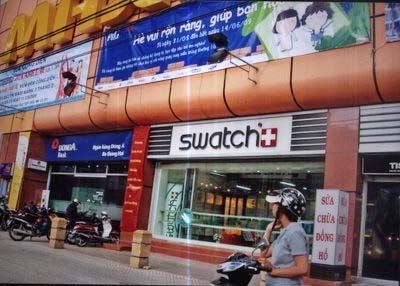
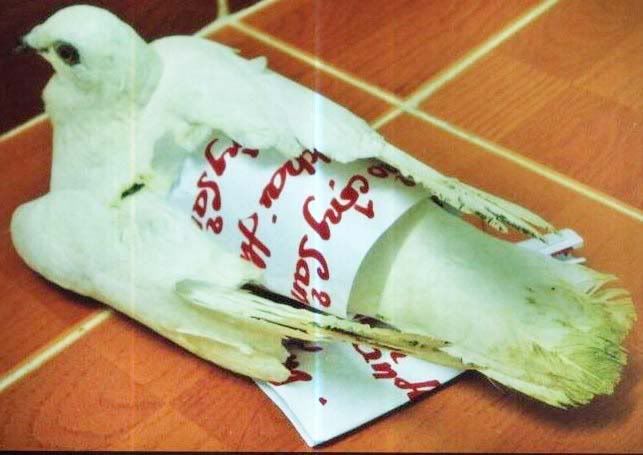 Ngày 15 tháng 6 năm 2009 tại trung tâm mua sắm Co.op Mart trên đường 3/2, thành phố Sài-Gòn, nhiều truyền đơn đả đảo đảng CSVN đã được đảng viên đảng DCND phát tán. Truyền đơn buộc vào chim bồ câu và đã được nhiều đảng viên Ðảng DCND giả làm người mua sắm thả ngay trong các khu vực mua bán thuộc trung tâm Co.op Mark. Chim bồ câu mang truyền đơn có nội dung phản đối đảng Cộng Sản Việt Nam cho Trung Quốc khai thác bauxite đã bay nhảy công khai trong các khu vực mua sắm trước chứng kiến của rất nhiều người.
 Create the pattern:


 Glue panels together:


