Liberal part leading: Is the Canadian general election approaching a tipping point?
08.10.2015 11:50
For much of this 78-day campaign season, the three parties - the incumbent Conservatives and the left-centre Liberals and New Democratic Party - have effectively been tied in the polls, all at around 30%.
Nanos poll: Liberals, Conservatives gripped in close race
Nanos National Ballot tracking released Oct. 8, 2015
If the Nanos Researchtracking pollis any indication, however, that could be changing. Starting on 26 September, the NDP - the often-overlooked left-leaning party that saw a surge in popularity in the past year culminating in a surprising provincial victory in traditionally conservative Alberta - began a precipitous decline, from 30.3% to its current 23%.
At first the Conservatives were the beneficiaries, but October has been kind to the Liberals, and they now stand atop the polls with 34.3%, ahead of the Conservatives' 32.1%.
Also encouraging for the Liberals is that 49.7% of poll respondents would consider voting for their party. only 41.6% said they would consider voting for the Conservatives, while 40.3% would entertain supporting the NDP. The ceiling, it seems, is higher for the Liberals.
Other surveys have the Conservatives edging the Liberals out - and still likely to win a plurality of seats in parliament - but there is undeniable evidence that the NDP is slipping.
"I want to see more of a consensus of pollsters but the Nanos numbers sure look like the start of something big," tweets Calgary-based political strategist Corey Hogan.
So what's behind this latest development?
A 30-30-30 balance all the way to the end was always bound to be unlikely, given that it requires a clear majority of voters opposed to Prime Minster Stephen Harper to stay evenly split between the NDP and Liberals. As the 19 October election day draws closer, left-leaning Canadians may become more disposed to strategic voting - that is, picking the party they view as more likely to unseat the Conservatives
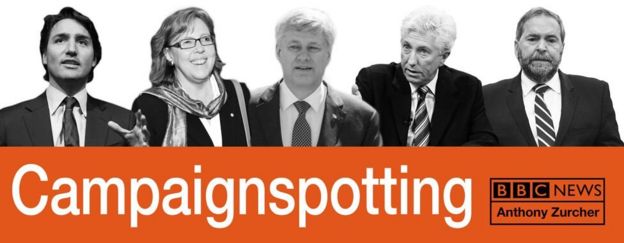
Of the two left-of-centre candidates, Liberal Justin Trudeau is considered to have emerged from the series of five English and French national debates in better shape than NDP's Thomas Mulcair.
Given that the Conservatives have attempted to brand Mr Trudeau as inexperienced and lacking the mettle to be prime minister, he had a manageable bar to clear for success.
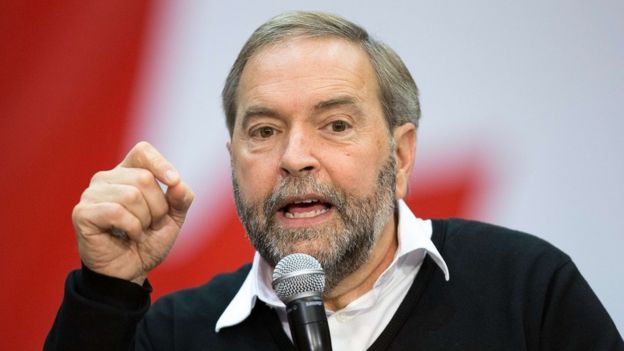
Image copyrightGetty ImagesImage captionThomas Mulcair has to convince Canadians to view the NDP as a party capable of running the nation
Canadian voters "were conditioned to expect a bumbling idiot", writes Adam Radwanski of the Toronto Globe and Mail. "By being pretty decent at what he does, he has fashioned a comeback story."
Meanwhile, the goal for Mr Mulcair was more nebulous - to sell the nationally untested NDP as a legitimate governing party on the left and a realistic alternative to the established Liberal brand. The recent decline may be evidence that his efforts have been unsuccessful.
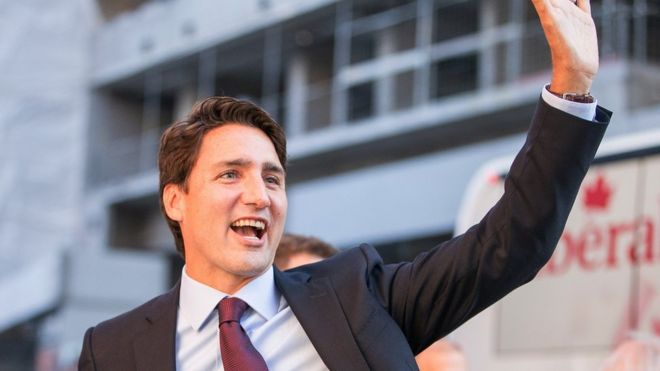
On Sunday, speaking at a hockey arena before a crowd of around 15,000 in a Toronto suburb, Mr Trudeau sounded like a candidate with the political wind at his back. He cast himself as the candidate for change and lambasted Mr Harper for being out of touch with Canadian voters on issues like the need to address income inequality and increase infrastructure spending.
He also condemned the prime minister for running what he says has been a divisive campaign playing on fears of outsiders and threats to national security. High on that list, according to Liberal critics, is Mr Harper's decision to limit the number of Syrian refugees admitted into the country, to support revoking citizenship of those convicted of terrorist offences and to challenge a recent court order allowing women to wear a head-covering niqab while taking a citizenship oath.
"In 10 years, Stephen Harper has never missed an opportunity to divide Canadians," Mr Trudeau said. "East against west. Urban against rural. French against English. So-called 'old stock' Canadians vs newcomers."
Canadian general election 2015
• Canadian election day is 19 October. Its formal campaign season lasts 78 days.
• The Canadian Parliament is comprised of 338 constituencies, called ridings.
• Members of parliament are elected in a "first past the post" system where the candidate with the most votes wins.
• Canada's prime minister is chosen by a majority vote in Parliament, either by one party or through a coalition.
"His first instinct is to appeal to the worst instincts," he continued. "He and his party have brought unprecedented nastiness to our country's public life. Their way of doing politics is mean and small and negative. It doesn't have to be that way, my friends."
He only took one swipe at Mr Mulcair, in French - likely targeting voters in Quebec, a former NDP stronghold that could be fertile ground for Liberal candidates.
With slightly under two weeks remaining until Canadian voters head to the polls, there could still be a few twists and turns in the campaign before it's all over, of course.
One possible wildcard is the recently concluded negotiations over the Trans-Pacific Partnership - which includes Canada, the US, Japan and nine other Pacific nations. It may provide a boost for the Conservative Party that inked the deal or Mr Mulcair, who has roundly condemned the agreement.
Mr Trudeau has only said that the agreement deserves "a fulsome and responsible discussion" in Parliament and that his party is "resolutely and consistently pro-trade".
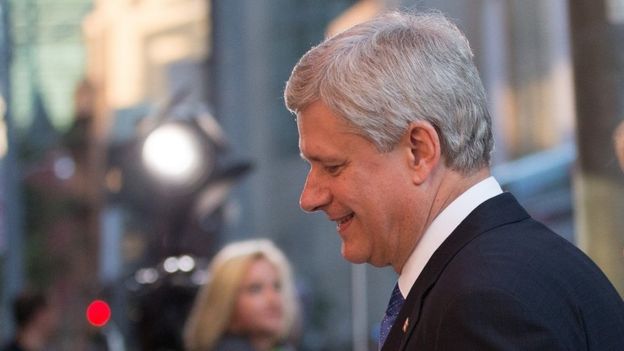
Image copyrightGetty ImagesImage captionMr Harper points to the recently concluded Trans-Pacific Partnership as a reason to re-elect Conservatives
"Because the election is only 13 days away, the TPP agreement could hardly have been more splendidly timed for the Conservatives," writes Lawrence Martin in the Globe and Mail. "Liberal Leader Justin Trudeau has been gaining momentum, breaking far in front of the NDP and passing the Conservatives in some polls. He is basing much of his campaign on the economy but now finds himself essentially agreeing with Stephen Harper on a major economic initiative."
Part of the NDP's previous rise can be attributed to its firm stand against the government surveillance law C-51, in contrast to the tepid support the Liberals gave the Conservative-backed measure.
Could TPP end up a reprise of this dynamic?
At this point it may be the NDP's last chance and - given the Conservative Party's reliance on divided opposition on the left for its most optimistic electoral scenario - Mr Harper's best hope.
Election 2015: Blue vs. Red; Orange flagging.
October 7, 2015
By Bruce Anderson & David Coletto
Liberals continue to edge upward, NDP downward
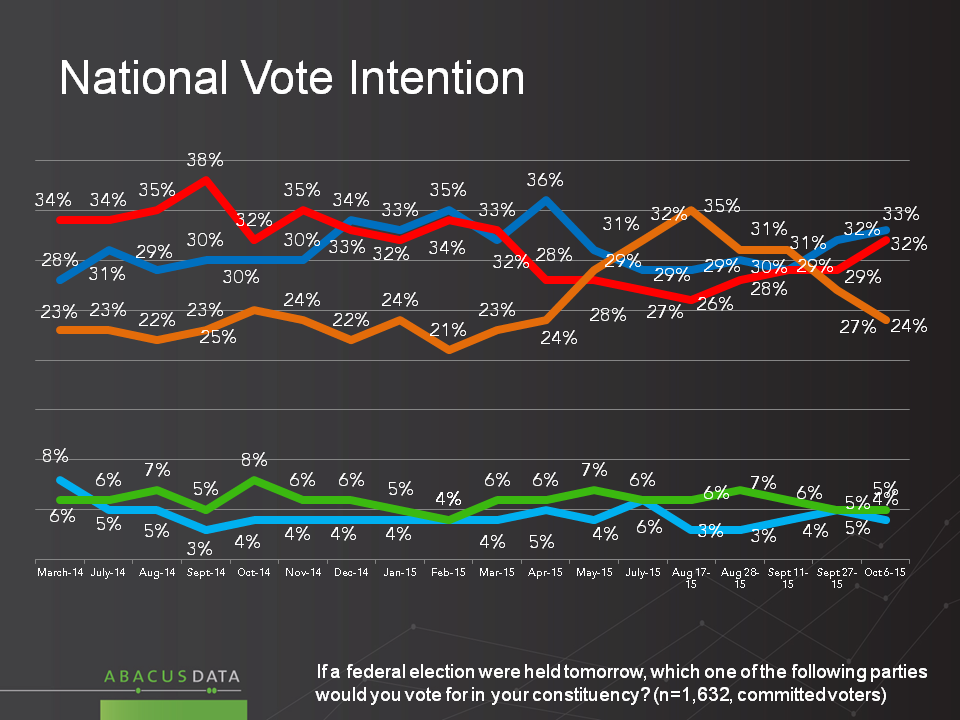
In our latest horserace numbers, the Conservatives have 33% across the country, the Liberals 32%, and the NDP 24%. For both the Conservatives and Liberals these are the best levels of support we’ve seen since the election started; for the NDP, it is the lowest number we’ve seen.
In ontario, we see the Liberals up 6 points from our last wave, and now with a 7-point lead over the Conservatives. The NDP have fallen back to 23%, down 9 points from the start of the election.
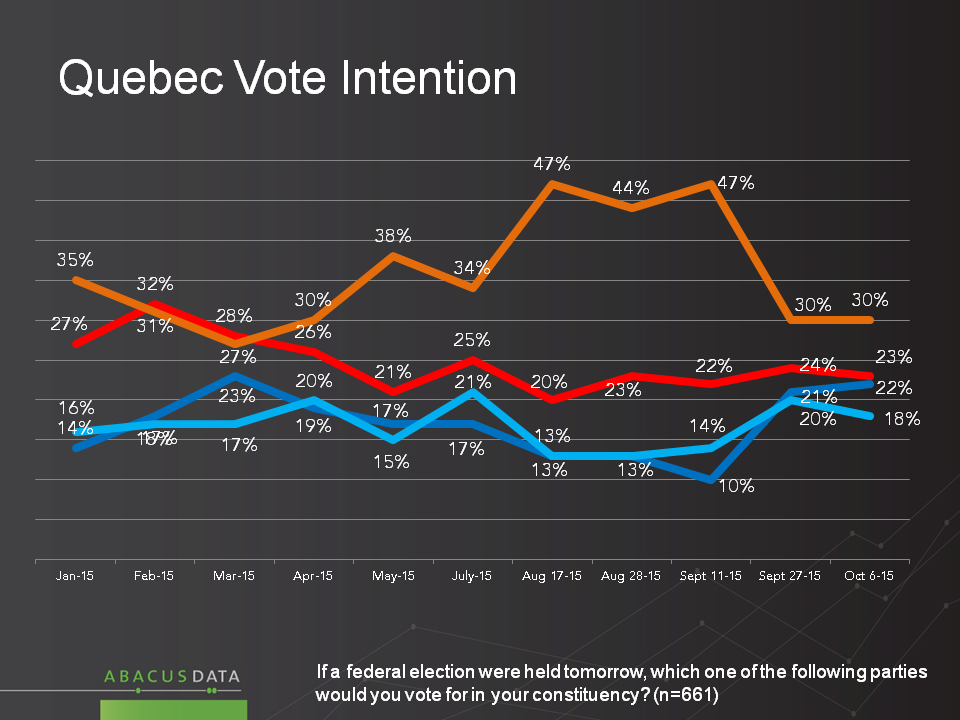
In Quebec, we see no significant change from our last wave: four parties are within 12 points of each other. The NDP started the election with a 27-point lead over the Liberals. Today, that lead is 7 points.
Accessible Voter Pools
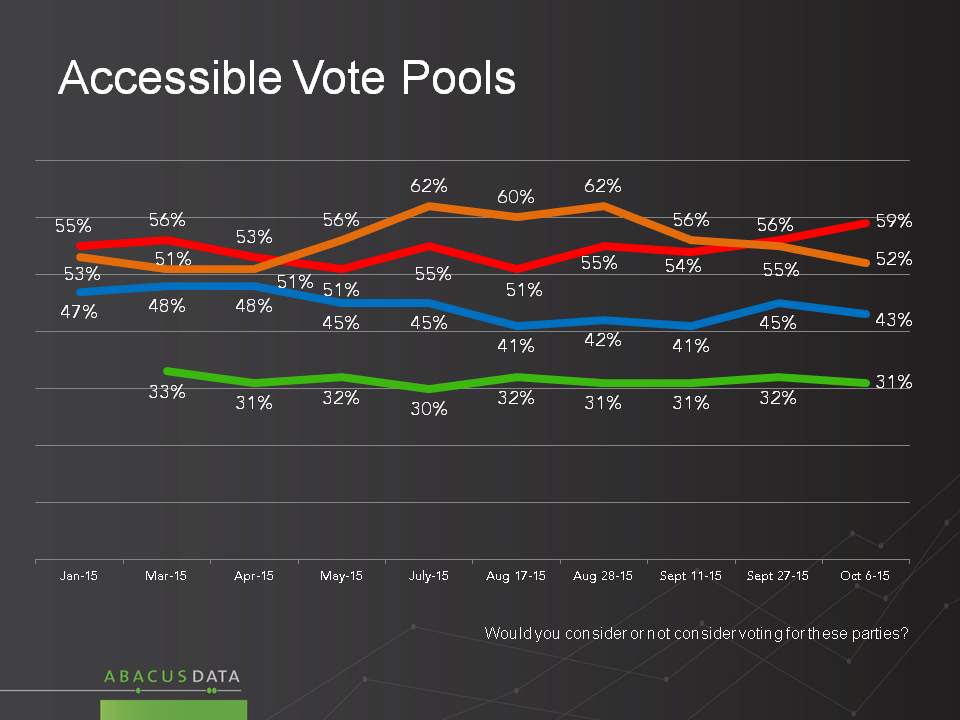
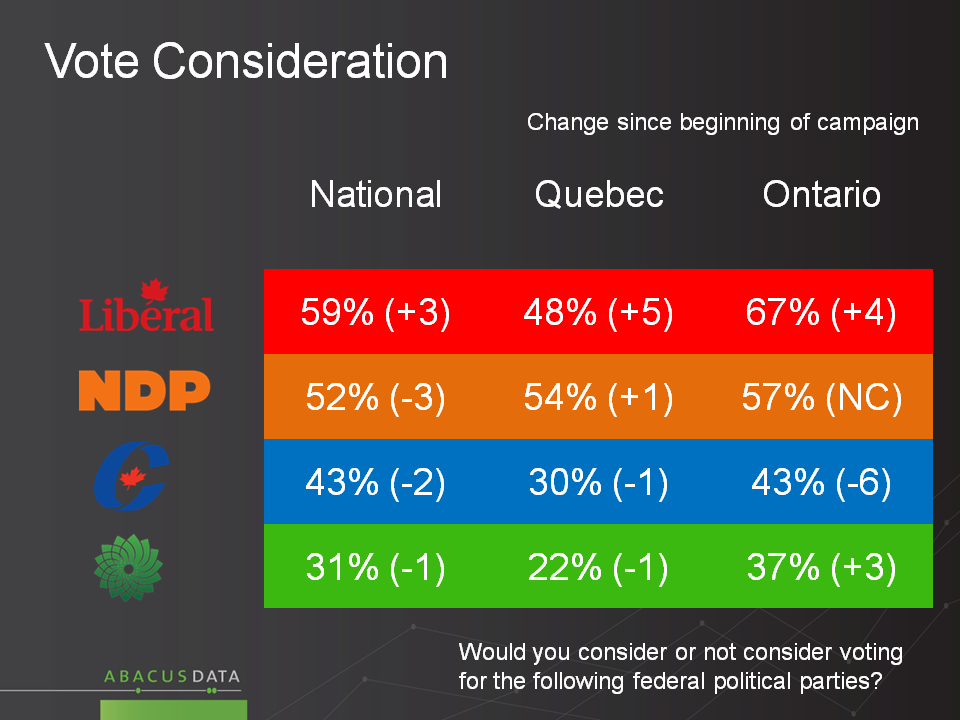
The Liberals now enjoy the largest number (59%) of accessible voters (people who say they would consider voting for a party), followed by the NDP (52%) and the Conservatives at 43%. Since the start of the campaign, the NDP pool has shrunk by 8 points, the Liberal pool has grown 8 points, and the Conservative pool has been pretty stable.
Worth noting is that the number of Quebec voters who would consider the Liberals is now 48%, and the number who would consider the Conservatives is 30%, unchanged from the last wave. In ontario, the accessible pool for the Liberals is 67%, up 4 points from our last wave, and 10 points higher than the NDP pool, and 24 points higher than the Conservatives.
The Leaders: Trudeau now most popular
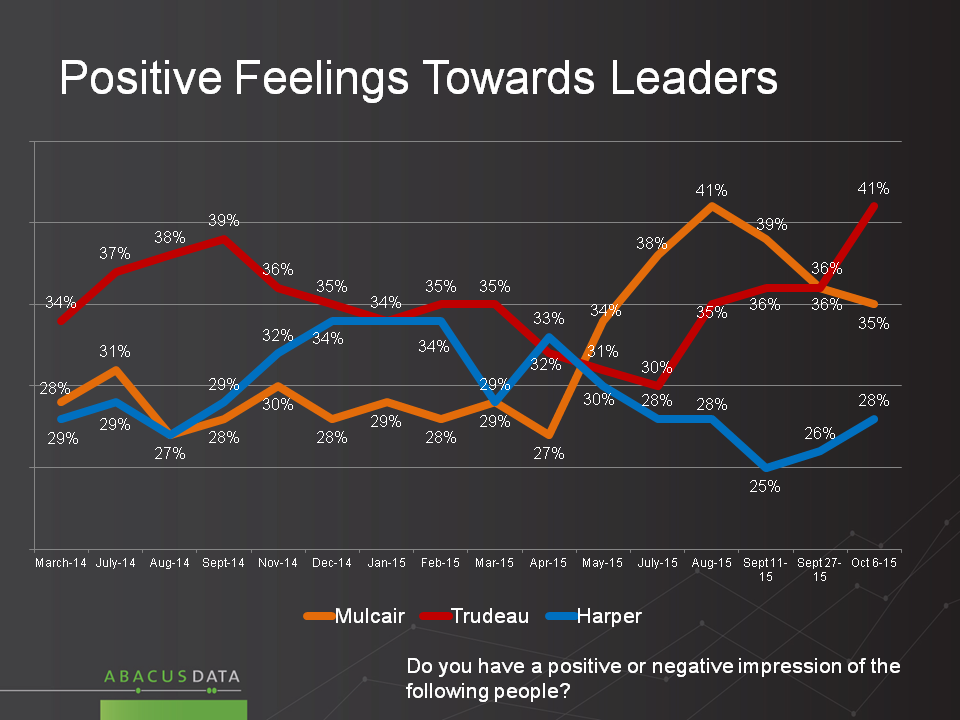
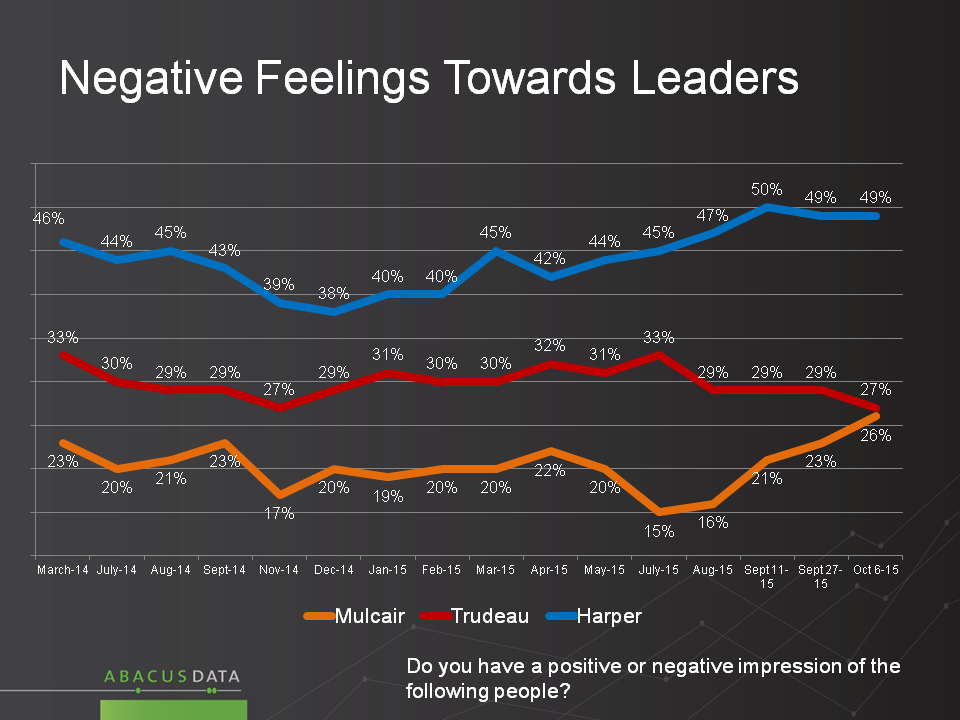
Positive feelings toward Justin Trudeau have been rising quickly in this campaign. In mid-July only 30% had a positive feeling about the Liberal leader, only 2 points better than Stephen Harper. At one point he trailed Thomas Mulcair by 8 points in positive regard. Today, Trudeau is up 11 points from his trough, and is 6 points better than Mr. Mulcair, and 13 points better than Mr. Harper.
Feelings about Mr. Harper have stayed in a fairly narrow range this election, while ratings of the NDP leader have seen significant losses. Negative feelings about the NDP leader are up from 15% to 26% in the last few months.
Who Voters Think Will Win
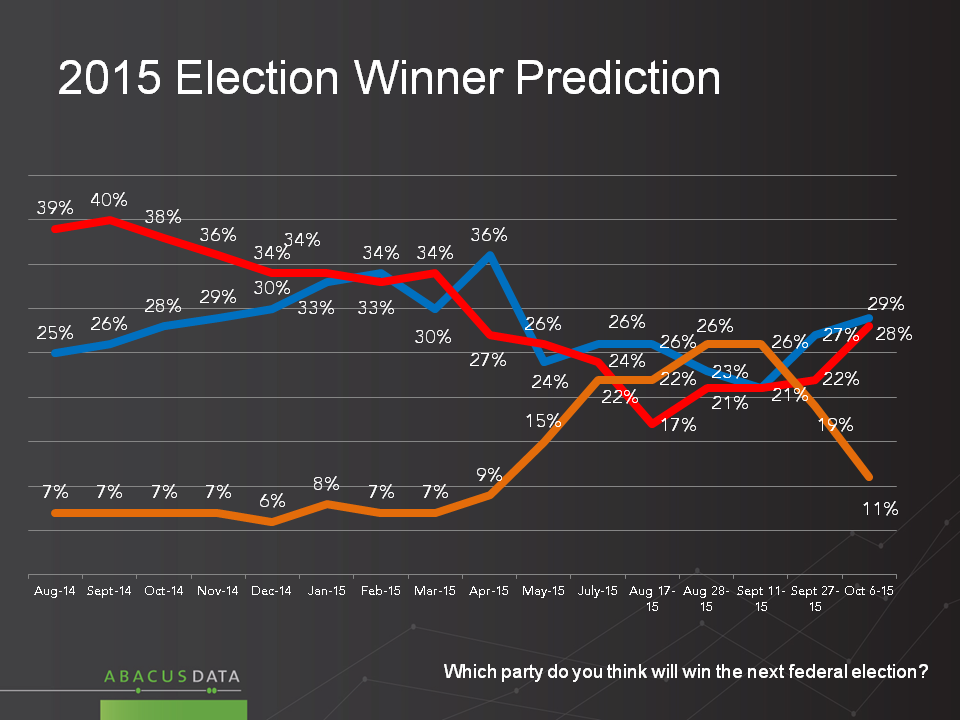
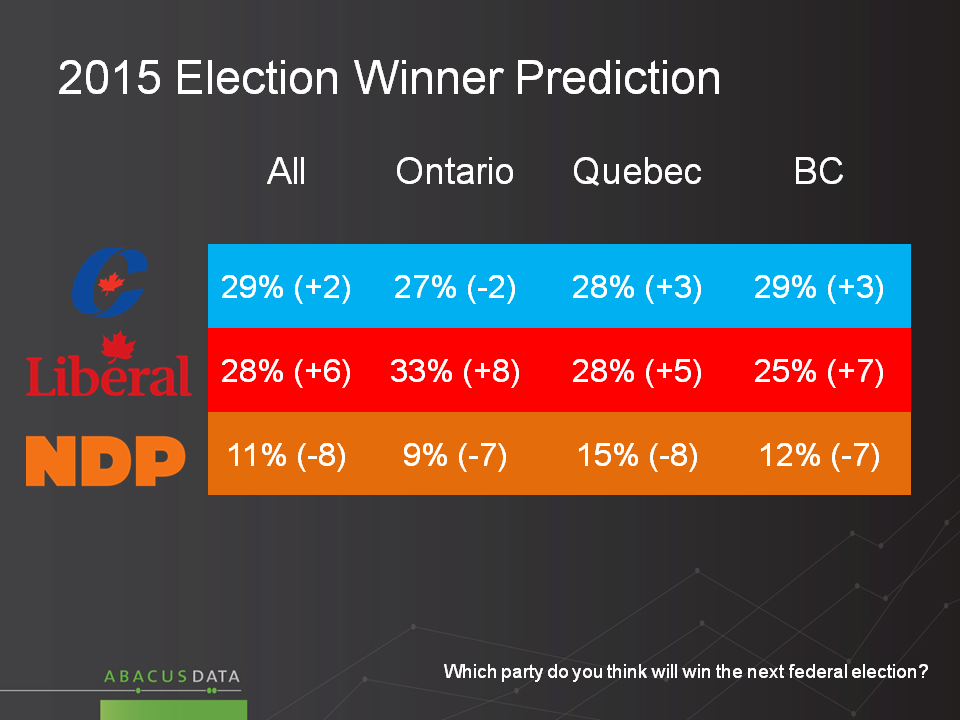
Two weeks ago, the NDP was picked as the likely winner of the election by a plurality (26%) of those surveyed. Today, only 11% believe the NDP will win, compared to 29% who think the Conservatives will win and 28% who think the Liberals will finish on top.
In ontario, 33% think the Liberals will win, followed by the Conservatives at 27% and the NDP at 9%. In Quebec, the CPC and LPC are deadlocked at 28%, followed by the NDP at 15%. In ontario and BC, the NDP have dropped 7 points on this question in just over a week, in Quebec they are down 8. As the race enters its final stages, and some voters consider strategic voting, it is clear that far fewer believe that the NDP is the party most likely to defeat the Conservatives.
The Upshot
The story so far of this election campaign has been one of relative steadiness in the prospects of the Conservatives, rising Liberal support, and declining enthusiasm for the NDP. The outcome at this point remains impossible to predict, especially since support levels continue to be fluid.
While much has been made about how the NDP platform may have positioned them poorly relative to the Liberals, it is also clear that feelings about the NDP leader are part of the challenge for that party. Mr. Mulcair, who began the campaign as a front-runner, has been leaving voters wanting. It seems reasonable to assume that at least some of this about reaction to his debate performances.
Mr. Trudeau, on the other hand, has capitalized on the fact that he started the campaign as something of an underdog, and has built substantially more opportunity for his party to stake a claim as the party best positioned to unseat the Conservatives, a point of differentiation which may be critical in the final days.
Tomorrow, we’ll provide data on the mood for change, the views of change voters, and reactions to the TPP deal.
- See more at: http://abacusdata.ca/election-2015-blue-vs-red-orange-flagging/#sthash.yM5AILKU.dpuf
Stephen Harper’s hypocrisy and hysteria on marijuana: Cohn
Like liberalizing beer sales in ontario, legalizing marijuana remains the last social taboo for politicians.
It's time for Canadian politicians, including Conservative Leader Stephen Harper, to come to their senses on legalizing marijuana, says Martin Regg Cohn.
By:Martin Regg CohnProvincial Politics,Published on Thu Oct 08 2015
Politicians know how to harvest the low hanging fruit at election time.
Now, Justin Trudeau has sniffed out the low hanging cannabis on the campaign trail — and promised to legalize it.
It’s time, long past time. The Liberal leader can make up for the sins — or omissions — of his father in failing to decriminalize marijuana possession generations ago, when Pierre Trudeau ignored the recommendations of the 1973 Le Dain Royal Commission he created as prime minister.
In fairness to Trudeau the elder, it was a different time. In the decades since, Canada has decriminalized homosexuality and legalized gay marriage.
In this campaign, the NDP is proposing to decriminalize dope. The Liberals want to take it one step further by legalizing — regulating — marijuana for sale in pharmacies (much like booze, still banned for minors).
Conservative Leader Stephen Harper has pounced, claiming Trudeau will imperil young people with poison (better to leave it to the dealers?). NDP Leader Tom Mulcair mocks his Liberal rival as a callow opportunist (better to maintain prohibition?).
We’ve just seen a variation on this theme play out in ontario. A province still suffering from its post-Prohibition hangover — and hang-up — beer sales were long restricted to a foreign-controlled monopoly.
Liberalizing beer sales remained a social taboo for politicians, creating perennial paralysis. None of the major parties would touch the topic during last year’s election.In retrospect, it was a missed opportunity for then-PC leader Tim Hudak. Ahead of the campaign, he had targeted the Beer Store, promising to rescind the chain’s outdated monopoly.
But at election time, he lost his nerve — and lost his way. Hudak himself now says he feared being belittled by his opponents for stooping to election gimmicks like beer in corner stores (just as the Conservatives now attack Trudeau, falsely claiming we’ll have cannabis in corner stores).
Now he’s watching Premier Kathleen Wynne, who barely spoke of beer during the campaign, stealing his ideas by phasing in sales to 450 grocery stores. Imitation is the sincerest form of flattery, but for Hudak it’s a bitter bottle of beer to swallow.
Beer surely wouldn’t have been a vote-determining issue, but it might have helped Hudak break through the static of a campaign when a candidate is constantly under attack. Equally for Trudeau, it’s hard to know how his marijuana position will influence voters, but it’s helping him get noticed with a younger demographic — and forcing the rest us of to take stock.
Prohibition ended in ontario in 1927, when lawmakers realized a complete ban on booze wasn’t working. It has taken until this year to start liberalizing the rules for selling beer.
Prohibition of marijuana came in 1922, when it was banned without any Parliamentary debate or scientific research. And it has taken until now to get serious about legalizing it, even though we’ve long known that prohibiting dope is a dopey idea.
As a 2002 Senate report noted, marijuana Prohibition was “a solution without a problem.”
Kids get it from local dealers, then grow up to be politicians who, in power, ask the police to throw kids in jail for doing what they once did. A clear sign that politics confuses hallucinatory with hypocrisy.
In 2013, Canada’s police chiefs declared that enough is enough: As a practical matter, they recommended that police merely hand out tickets for possession, rather than locking people up. It was a clear rebuke by police of the “Safe Streets” Act passed by Harper’s government the year before, which set mandatory minimum jail terms (26,000 Canadians were charged with simple possession in 2012 — compared to two women in niqabs at citizenship ceremonies, sparking the latest prohibition craze).
Out of phase with modern policing, the Conservative Party is also out of sync with modern science. Harper has responded to Trudeau’s platform by claiming that “marijuana is infinitely worse” than tobacco, based on “growing scientific and medical evidence” — when the facts from all sources clearly shows the opposite.
As the Canadian Medical Association Journal reminds politicians in its latest election issue, banning dope merely fuels an illegal drug trade that does more harm than good. It wastes more than $1.2 billion a year in law enforcement resources, stigmatizes 500,000 people with criminal records because of cannabis possession, and drives drug users underground.
Just as Prohibition flopped for booze, criminalizing cannabis is a war without a cause. We’ve known this since the seventies, but allowed anti-drug hysteria to cloud our thinking.
Time, at last, for Canada’s politicians to stop hallucinating and hyperventilating about marijuana. Time, in fact, to take a deep breath — even if they claim never to have inhaled — and come to their senses about dope.
Martin Regg Cohn’s Ontario politics column appears Tuesday, Thursday and Sunday. mcohn@thestar.ca , Twitter: @reggcohn
Liberals move back into lead, new Forum poll finds
Forum’s latest results put the Conservatives and the Liberals in a virtual tie in Parliament.
MARK BLINCH / REUTERS FILE PHOTO
In ontario, Justin Trudeau and the Liberals hold a slim lead with 38 per cent support, the Conservatives are sitting at 33 per cent and the NDP has dropped to 23 per cent, according to the latest Forum Research poll.
By:Donovan VincentNews reporter,Published on Thu Oct 08 2015
The Liberals have moved into the lead in the latest Forum Research poll, collecting 35 per cent support to 31 per cent for the Conservatives and 26 per cent for the NDP.
The Greens and the Bloc round out the field with 3 and 4 per cent respectively, and 1 per cent of respondents said they plan to vote for “other.”
The Liberals haven’t had sole possession of the lead in a Forum poll since mid-June, and the last time the party was out in front with this wide a margin over second place was March 14, when they stood at 36 per cent support, to 32 per cent for the Conservatives, and 21 per cent for the NDP.
In ontario, the Liberals hold a slim lead with 38 per cent support, the Conservatives are sitting at 33 per cent and the NDP has dropped to 23 per cent.
In Quebec, where the controversy over the niqab face veil worn continues to rage, the NDP remain in front ahead of the Liberals 34 per cent to 24 per cent support. The Conservatives sit at 23 per cent, the Bloc Québécois 16 per cent, the Greens 2 per cent, and “other” 1 per cent.
While the niqab controversy continues to be on the minds of some voters, the latest Forum poll found 73 per cent said the issue won’t influence their vote, 20 per cent of respondents said it will. About half of the latter category (11 per cent) said the issue will influence them a “great deal.”
Forum president Lorne Bozinoff argues the results suggest that while Stephen Harper’s support for a niqab ban has traction in Quebec, his position on the issue may be “backfiring” elsewhere in Canada.
With a tight two-way race underway heading into the election, Forum asked respondents their views on a possible coalition government. Fifty-eight per cent of those polled said they feel two or more parties forming a coalition is appropriate. Fifty-two per cent support the idea of a Liberal-NDP coalition, while 38 per cent said they oppose that scenario, and 9 per cent answered “don’t know.”
The Liberal, NDP, and Conservative campaigns did not provide comment Wednesday on the latest Forum results.
Results from the latest Forum poll are based on a random, interactive voice response telephone survey of 1,447 adult Canadians, conducted Oct. 5 and 6. The results are considered accurate plus or minus 3 percentage points, 19 times out of 20.
Forum’s poll is weighted statistically by age, region and other variables to ensure the sample reflects the actual population according to the latest census data. The weighting formula has been shared with the Star and raw polling results are housed at the University of Toronto’s political science department’s data library.
Harper pitting country against Muslims, some Niqab wearers say
Three Canadian women who wear the face veil say Conservative Leader Stephen Harper’s rhetoric risks pitting the country against its Muslim citizens.
As Stephen Harper hardens his anti-niqab position on the campaign trail, three Canadian women who wear the face veil say the Conservative leader’s rhetoric risks pitting the country against its Muslim citizens.
The Conservatives have long opposed women wearing the face covering at Canadian citizenship ceremonies, but with the federal election less than two weeks away, Harper doubled down this week by suggesting that if re-elected, he would consider passing a law banning the veil from the federal public service.
But Rezan Mosa, a 22-year-old native of Vancouver, says she is no less of a Canadian just because she decides to don the veil.
“I was born and raised here,” she said. “I have a right to be here, this is my country. I’m very proud to be Canadian.”
Mosa, a student at Brescia University College in London, ont., said that as anti-niqab sentiment has ramped up on the campaign trail in recent weeks, she’s experienced more incidents of discrimination.
“There’s definitely a noticeable difference,” said Mosa, who began wearing the veil over 18 months ago. “Just a lot more people staring, making comments, telling me to go back to my country.” She said the incidents have made her “feel very unsafe.”
GEOFF ROBINS / TORONTO STAR Order this photo
Rezan Mosa, a student at Brescia University College in London, ont., said that as anti-niqab sentiment has ramped up on the campaign trail in recent weeks, she’s experienced more incidents of discrimination.
Mosa said she’s also worried about what the proposed ban on niqabs in the public service could mean for her job prospects. A joint sociology and religious studies major, she’s considered working for government-funded agencies after she graduates.
“If I was banned from wearing the niqab, my whole career is on the line,” she said.
Mosa is not the only woman concerned by how the niqab issue is playing out during the election. Shomyla Hammad, who lives in Mississauga, has been wearing the niqab for seven years and said that her fellow Canadians have always accommodated her.
“I have never had any bad feelings from anyone,” she said. “I just wouldn’t be anywhere in the world with my niqab but in Canada.”
But she believes Harper is trying to “put fear in people’s minds” in order to win votes, and she worries the veil could become stigmatized.
“The way that Stephen Harper is politicizing the issue, that is really, really bad . . . it just scares me,” said Hammad, a 42-year-old mother of two.
Afia Baig, a Mississauga woman who also wears the niqab, said she has been in Canada for nearly 20 years without being targeted for how she dresses, and she doesn’t feel personally threatened by the ongoing debate.
But she said she is angry by what she sees as Harper’s Conservatives playing politics with the rights of minorities over a non-issue.
A 57-year-old immigrant from South Asia, she said that about 15 years ago she took the citizenship oath while wearing the niqab, after first uncovering her face to confirm her identity. “It was not ever an issue,” she said.
“They have used this to instill hate amongst Canadian people. It’s so infuriating, it’s so bad and so wrong. We feel we’re being used for his election games.”
Despite Harper describing the niqab as “anti-women,” Mosa, Hammad and Baig all told the Star they decided to wear the veil on their own for religious reasons, in some cases over the objections of male relatives who feared they would be discriminated against.
Meanwhile, advocacy groups are raising concerns about anti-Muslim behaviour popping up across the country. The National Council of Canadian Muslims said it has received several reports of Muslim women being verbally or physically assaulted in the last month. It pointed to a disabled Muslim 19-year-old woman who reported to police that she was verbally threatened at an Ottawa shopping centre. The Star could not independently verify the report.
The group tracks such incidents and recorded the details on its website, saying the woman was “young, visibly Muslim and disabled” when a middle-aged white man told her “to remove ‘the f---ing rug off (her) head.’ ”

 Các chuyên mục