Dân Canada muốn có thủ tướng mới: Justin Trudeau sắp nối nghiệp cha? How Vietnamese vote?
06.09.2015 03:53
Đảng Liberal đang tăng đà thắng thế Đảng Tân Dân Chủ (NDP) tuần trước dẫn đầu nhưng đa số chỉ nằm trong tỉnh bang Quebec, trên thực tế nó đang mất đà dần để Đảng Tự Do dẩn đầu trong phần còn lại của Canada, theo một cuộc thăm dò của tổ chức Léger.. Justin Trudeau Cố thủ tướng Pierre Trudeau (cha)Latest Poll Sept. 21, 2015
Conservative
27%
NDP
30%
Liberal
33%
Bloc
5%
Green
4%
Cuộc khảo sát của 2,119 người Canada cho thấy Đảng Tự do dưới Justin Trudeau đang thắng thế dẫn đầu khắp nước.
Đa số người Québec bỏ cho NDP là phần lớn không thích đảng Conservative và Libéral cũng như những phần tử ly khai vì lập trường cho phép ly khai của đảng chỉ cần 50% + 1 lá phiếu là Québec được phép ly khai khỏi Canada và thành quốc gia Québec độc lập. trong đó có 40,000 người VN sẽ mang quốc tịch và passport Québec. Trudeau đã được tăng ủng hộ trong những tuần gần đây, đặc biệt là ở các nơi chính yếu ở tỉnh bang Ontario.
Thăm dò dư luận mới nhất hôm qua cho biết những con số thăm dò ý kiến mới, được xuất bản lần đầu tiên trong The Globe and Mail, cho thấy Canada đang tiến tới một chính phủ thiểu số tại thời điểm này, và đó là một đa số rõ ràng của các cử tri muốn có một thủ tướng mới vào ngày 19 Tháng 10 . Câu hỏi đặt ra là liệu ông Trudeau hoặc NDP Leader Thomas Mulcair sẽ "lấy thời điểm này," ông nói.Theo thăm dò mới nhất hôm qua, Đảng Dân chủ mới có sự hỗ trợ của 30 phần trăm số người được hỏi ở cấp độ quốc gia, trước đảng Tự do ở 32 phần trăm và Đảng Bảo thủ Stephen Harper 31 phần trăm. Tuy nhiên, Léger cho biết đảng Tự do đã tăng thêm một điểm mỗi tuần trong suốt chiến dịch, thu hẹp khoảng cách với các NDP trên toàn quốc. Cựu thủ tướng Paul Martin và Justin Trudeau Trong Ontario, Léger có đảng Tự do ở 37 phần trăm, trước đảng Bảo thủ (28 phần trăm) và NDP (27 phần trăm). Tại Quebec, mặt khác, các NDP là một lực lượng chi phối (46 phần trăm), vượt xa các đảng Tự do (20 phần trăm), Khối Québécois (18 phần trăm) và đảng Bảo thủ (13 phần trăm)."Đảng NDP đã bắt đầu đến đỉnh và thậm chí bắt đầu để rơi trở lại", "Sự trỗi dậy của NDP trong hỗ trợ đã được giới hạn bởi các tường Ontario -. Họ không đột phá mới trong tỉnh bang Ontario" Cuộc thăm dò được tiến hành từ thứ Hai và thứ Tư của tuần này là dân Canada được biết rằng đất nước này đang trong tình trạng suy thoái trong nửa đầu năm nay, nhưng trước khi cuộc khủng hoảng người tị nạn Syria đã thống trị chiến dịch. Tháng trước, các thử nghiệm của Thượng nghị sĩ Mike Duffy về tội gian lận, vi phạm lòng tin và hối lộ là một chủ đề nổi bật. "Một khi bạn yếu tố trong phiên tòa Duffy, có rất nhiều câu chuyện tiêu cực đè nặng lên đôi vai của Đảng Bảo thủ," Léger cho biết.
Ông nói thêm rằng, theo quan điểm của mình, tháng đầu tiên của chiến dịch là về một vấn đề lớn: "Bạn có muốn giữ cho chính phủ hiện nay"
Cho rằng 64 phần trăm số người được hỏi cho biết họ sẽ "thích sự thay đổi của chính phủ" trong cuộc bầu cử này, ông Léger cho biết các câu hỏi quan trọng bây giờ là: "Ai nên trở thành thủ tướng tiếp theo?" "Chỉ có 24 phần trăm số người được hỏi cho biết họ muốn chính phủ hiện tại để được tái đắc cử, đó là ít hơn so với mức hiện tại của Đảng Bảo thủ của hỗ trợ," Léger nói
Ông cho biết cuộc tranh luận The Globe and Mail lãnh đạo nền kinh tế sẽ được tổ chức vào ngày 17 tháng 9 tại Calgary trong khi người Canada bắt đầu củng cố ý định bỏ phiếu của họ. "Các cuộc tranh luận ngày 17 tháng 9 sẽ đến vào một thời điểm quan trọng. Sẽ có một lúc Trudeau? Ông sẽ cho thấy rằng ông là đủ mạnh? "Ông Léger nói. "Cùng một câu hỏi sẽ được yêu cầu của ông Mulcair."
Cho đến nay, các cuộc thăm dò cho thấy Léger hỗ trợ cho NDP vẫn còn tương đối yếu hơn so với các đối thủ của nó. Gần một nửa (49 phần trăm) số cử tri NDP cho biết họ vẫn có thể thay đổi ý định của họ, nhiều hơn các cử tri tự do (41 phần trăm). Mặt khác, chỉ có 29 phần trăm cử tri bảo thủ cho biết họ vẫn có thể thay đổi tâm trí của họ.
Ông nói thêm rằng Léger ủng hộ đảng Dân chủ mới là rất có thể, ở mức 42 phần trăm, để nói rằng họ sẽ "bỏ phiếu chống lại một bên" trong cuộc bầu cử này, so với 31 phần trăm cho cử tri tự do. Ông nói điều này cho thấy rằng những người ủng hộ NDP là "cử tri chiến lược", những người có thể chuyển sang một bên tùy thuộc vào sự tiến triển của chiến dịch bầu cử.
Các cuộc thăm dò trực tuyến được coi là chính xác trong vòng 2,1 điểm phần trăm, 19 lần trong số 20. Léger thăm dò ý kiến 1.010 của 2119 người trả lời của mình ở Quebec để có được một bức tranh rõ ràng hơn về tỉnh, nhưng trọng các câu trả lời dựa trên chia sẻ của tỉnh trong những cư dân Canada. Chính phủ thủ tướng Pierre Trudeau đã mở rộng vòng tay đón người tị nạn VN đến Canada năm 1975. Đơn vị tranh cửa của ông Trudeau nơi đa số cử tri gốc Việt định cư và kinh doanh sẽ quyết định chiến thắng hay thất bại. Chúng ta hãy dồn phiếu cho vị thủ tướng nhiệm kỳ sắp tới nầy.
Hệ thống chính phủ nghị viện của Canada dựa trên mô hình của Liên hiệp vương quốc Anh. Quốc hội liên bang Canada gồm quốc vương (đại diện tại Canada là Toàn quyền), Thượng viện với các thành viên do Toàn quyền chỉ định dựa trên khuyến nghị của Thủ tướng và Hạ viện với các thành viên do các công dân Canada bầu ra thông qua các cuộc bầu cử phổ thông toàn liên bang.
Nhiệm kỳ của các Thượng nghị sỹ sẽ kéo dài cho đến khi họ 75 tuổi. Nhiệm kỳ của các Hạ nghị sỹ không cố định. Hạ viện sẽ được bầu lại trong vòng tối đa không quá năm năm một lần. Toàn quyền sẽ giải tán Quốc hội và kêu gọi một cuộc bầu cử mới theo khuyến nghị của Thủ tướng vào thời điểm nào mà Thủ tướng thấy có lợi nhất cho vị trí của đảng mình tại Quốc hội.
Hội đồng bầu cử Canada (Elections Canada) là một cơ quan không đảng phái chịu trách nhiệm tổ chức các cuộc bầu cử liên bang, các cuộc bầu cử bổ sung và trưng cầu dân ý. Chủ tịch Hội đồng được gọi là Cán bộ bầu cử chính của Canada.
Quyền đại diện trong Hạ viện
Quyền đại diện trong Hạ viện dựa trên sự phân chia về địa lý được gọi là đơn vị bầu cử (riding). Mỗi khu vực bầu cử chọn một đại diện trong Hạ viện và số lượng các khu vực bầu cử được quyết định bằng một công thức được quy định trong Hiến pháp. Các ủy ban độc lập quyết định các khu vực bầu cử dựa trên dân số và các mối quan hệ về kinh tế và xã hội. Các ủy ban này được thành lập sau mỗi cuộc điều tra dân số được tổ chức 10 năm một lần để xem xét lại số lượng các khu vực bầu cử hiện có theo các tiêu chí được quy định trong Luật điều chỉnh các khu vực bầu cử. Quá trình quyết định lại các khu vực bầu cử được gọi là phân phối lại và kết quả sẽ được ghi nhận trong một bộ luật về quyền đại diện. Luật về quyền đại diện năm 2003 quy định số khu vực bầu cử là 308 (Luật năm 1996 quy định số khu vực bầu cử là 301).
Đa số tương đối
Hệ thống bầu cử của Canada được coi là hệ thống “đa số tương đối”. Tại mỗi khu vực bầu cử, ứng cử viên có số phiếu nhiều nhất sẽ giành quyền đại diện tại Hạ viện và đại diện cho khu vực bầu cử đó với tư cách là một Nghị sỹ (MP). Điều này có nghĩa là các ứng cử trúng cử viên không nhất thiết phải có được trên 50% phiếu bầu (đa số tuyệt đối).
Không có giới hạn về số lượng ứng cử viên tại mỗi khu vực bầu cử, tuy nhiên mỗi ứng cử viên chỉ được ứng cử tại một khu vực bầu cử, với tư cách độc lập hoặc đại diện cho một đảng chính trị hợp pháp nào đó. Mỗi đảng cũng chỉ được cử một ứng cử viên tranh cử tại một khu vực bầu cử. Các ứng cử viên tranh cử mà không thuộc đảng phái nào có thể được gọi là các ứng cử viên “độc lập” hoặc “tự do”.
Một đảng chính trị là một nhóm các cá nhân cùng nhau thiết lập nên một cơ cấu và các quy chế, bầu ra một lãnh đạo và ban điều hành chuyên trách, và đề cử các ứng viên tranh cử cho cuộc bầu cử Hạ viện. Để giành quyền tranh cử dưới tên gọi của đảng cho các đảng viên của mình, một đảng chính trị phải đăng ký với Cán bộ bầu cử chính. Có 12 đảng chính trị đăng ký tranh cử trong cuộc bầu cử năm 2004 (so với 11 năm 2000).
Sau một cuộc bầu cử, đảng giành được nhiều ghế tại Hạ viện nhất thường trở thành đảng lãnh đạo. Lãnh đạo của đảng này trở thành Thủ tướng và lựa chọn các cá nhân (thường là các Hạ nghị sỹ thuộc đảng của mình) vào vị trí lãnh đạo các bộ khác nhau của chính phủ. Đảng có số lượng Hạ nghị sỹ lớn thứ hai sẽ trở thành “đảng đối lập chính thức”. Tất cả các ứng cử viên thắng cử sẽ có một ghế tại Hạ viện, ở đó họ bỏ phiếu thông qua các dự luật và qua đó tác động đến chính sách của chính phủ.
Nếu lãnh đạo đảng chiếm nhiều ghế nhất tại Quốc hội (tân Thủ tướng) không thắng cử trong cuộc bầu cử liên bang, một Hạ nghị sỹ của đảng đó sẽ phải từ chức và một cuộc bầu cử bổ sung sẽ được tiến hành để bầu một Hạ nghị sỹ mới là chính tân Thủ tướng. Sự lựa chọn Hạ nghị sỹ và khu vực bầu cử lúc này rất quan trọng vì đảng lãnh đạo phải chắc chắn vào thắng lợi của tân Thủ tướng nếu không muốn phải tổ chức tiếp một cuộc bầu cử bổ sung khác và tự làm giảm uy tín của chính mình.
Các cán bộ bầu cử không đảng phái
Các cán bộ bầu cử phải trung lập về chính trị: họ không được ủng hộ bất cứ một đảng hay một ứng cử viên nào. Các biện pháp đề phòng đặc biệt sẽ được thực hiện nhằm đảm bảo rằng không một đảng phái nào có thể có tác động đến việc điều hành các hoạt động bầu cử. Tất cả các cán bộ bầu cử phải thề sẽ bảo vệ các quyền của cử tri, giữ bí mật cho phiếu bầu và tiến hành mọi công việc mà không thiên vị bất cứ ai.
Vào ngày bầu cử, mỗi ứng cử viên có thể cử đại diện của mình giám sát việc bầu cử và kiểm phiếu để chắc chắn rằng mọi việc đã được tiến hành công bằng và đúng luật.
Đảm bảo quyền bầu cử của tất cả mọi người
Mọi công dân Canada đủ 18 tuổi trở lên vào ngày bầu cử đều có quyền đi bầu cử, kể cả người vô gia cư và tù nhân, nếu họ đăng ký với Hội đồng bầu cử. Mọi công dân Canada nếu có quyền bầu cử cũng có quyền ứng cử, trừ các cán bộ bầu cử, các ủy viên hội đồng lập pháp các tỉnh và vùng lãnh thổ.
Mọi công dân đều có quyền có tiếng nói trong việc lựa chọn người đại diện cho mình trong Quốc hội. Luật bầu cử của Canada đòi hỏi Cán bộ bầu cử chính phải thông báo cho công chúng biết về hệ thống bầu cử của Canada và về các quyền của mỗi cá nhân trong hệ thống đó và giải quyết mọi khó khăn có thể xảy ra đối với bất cứ ai trong việc đi bầu cử.
Trong quá trình bầu cử, Hội đồng bầu cử thông báo cho tất cả mọi người Canada về quyền được bầu cử của họ, cách đăng ký bầu cử và ghi trên vào danh sách sử tri và cách bầu cử. Các hoạt động thông tin tuyên truyền của Hội đồng này bao gồm thông cáo báo chí, quảng cáo trên các báo, đài truyền hình và đài phát thanh, tờ rơi, áp-phích, băng hình, các hộp thư trả lời điện thoại miễn phí, trang tin điện tử và họp mặt với các cộng đồng và các nhóm dân tộc thiểu số.
Giữa các kỳ bầu cử, Hội đồng phát hành các thông tin nền tảng bổ sung cho công chúng, duy trì các hộp thư trả lời điện thoại miễn phí và trang tin điện tử để trả lời các câu hỏi và hợp tác với các nhà giáo dục để khuyến khích các công dân trẻ đi bầu cử khi họ đủ tuổi.
Giải quyết các khó khăn trong việc bầu cử là một phần quan trọng trong các công việc của Hội đồng bầu cử Canada. Các cử tri không thể đi bầu cử vào ngày bầu cử có thể bầu cử trước. Một hòm bầu cử đặc biệt được chuẩn bị cho những người Canada vắng mặt tại khu vực bầu cử của mình, những người đi du lịch hoặc đang sinh sống ngắn hạn ở nước ngoài. Thậm chí những cử tri đang sống tại khu vực bầu cử của mình cũng có thể sử dụng hòm bầu cử này nếu họ không muốn đi đến điểm bầu cử. Trong những trường hợp đặc biệt, cử tri bị tàn tật có thể bầu cử tại nhà với sự chứng kiến của một cán bộ bầu cử. Các hòm bầu cử di động phục vụ các cử tri sống tại một số cơ sở đặc biệt, ví dụ như các trại an dướng cho người già hoặc người tàn tật.
Vào bất cứ chỗ nào có thể, các cán bộ bầu cử tại các điểm bầu cử phải sử dụng được cả hai ngôn ngữ chính thức. Ngoài ra, các phiên dịch cũng có thể được triệu tập để trao đổi với các cử tri.
Đối với các cử tri cần sự hỗ trợ đặc biệt, phần lớn các điểm bầu cử đều có đường đi riêng, hoặc được chuyển sang bầu cử ở một điểm khác có đường đi riêng. Cũng có những mẫu phiếu bầu cử đặc biệt cho những người khiếm thị. Khi được yêu cầu, một cán bộ bầu cử có thể giúp đỡ một cử tri tàn tật hoặc một cử tri không biết đọc để họ có thể bầu cử. Gia đình hoặc bạn bè cũng có thể hỗ trợ họ. Hội đồng bầu cử Canada duy trì một đường dây liên lạc miễn phí qua điện thoại đặc biệt đành cho những người khiếm thính.
Vượt qua những thách thức về địa lý
Hệ thống bầu cử ở Canada đã phát triển để đáp ứng được quy mô địa lý của Canada. Canada mặc dù có dân số không lớn nhưng lại trải rộng trên một diện tích vô cùng rộng lớn, nhiều vùng chỉ có thể đến được bằng máy bay và nhiều vùng thậm chí còn không thể tiếp cận được. Vì vậy, một số khu vực bầu cử bao gồm cả một vùng đất đai rộng lớn nhưng thưa dân. Ví dụ như khu vực bầu cử Nunavut bao gồm toàn bộ vùng lãnh thổ Nunavut có diện tích 3,1 triệu km2 nhưng chỉ có 21.000 người. Trong khi khi đó khu vực bầu cử Laurier–Sainte-Marie ở Quebec chỉ có 9km2 lại có dân số tới 96.000.
Giờ đi bầu cử chậm dần tại các vùng do Canada có sáu múi giờ khác nhau. Vì vậy kết quả bỏ phiếu được công bố gần như cùng một lúc trên phạm vi toàn quốc.
II. Cuộc bầu cử liên bang lần thứ 38
Quốc hội thứ 37 của Canada được bầu vào ngày 27-11-2000 và đã được Toàn quyền Andrienne Clarkson giải tán ngày 23-5-2004. Cuộc bầu cử Quốc hội thứ 38 được quyết định vào ngày 28-6-2004 để lựa chọn ra 308 Hạ nghị sỹ đại diện cho 308 khu vực bầu cử tại tất cả các tỉnh và vùng lãnh thổ của Canada.
Các đảng tham gia tranh cử
Đăng ký tranh cử tại cuộc bầu cử lần thứ 38 này có 12 đảng chính trị, trong đó có bốn đảng lớn là: Đảng Tự do, Đảng Bảo thủ, Đảng Bloc Quebec và đảng Dân chủ mới; và tám đảng khác là Đảng Hành động, Đảng Di sản Cơ đốc giáo, Đảng Người tự do, Đảng Cần sa, Đảng Cộng sản, Đảng Xanh, Đảng Mác-xít Lê-nin-nít và Đảng Cấp tiến. Bốn đảng đầu tiên được coi là đảng chính vì chúng là những đảng đã từng cầm quyền hoặc đã từng có đại diện tại Hạ viện. Đảng tự do hiện đang nắm quyền lãnh đạo đất nước và trong toàn bộ lịch sử 137 năm của Canada đã cầm quyền với tổng thời gian là 92 năm. Đảng Bảo thủ hiện nay mới được tái thống nhất năm 2003 từ Đảng Liên minh và Đảng Bảo thủ cấp tiến. Đảng Bloc Quebec có các đảng viên chủ yếu ở tỉnh Quebec và có chủ trương chính là hướng tới việc thành lập một quốc gia Quebec độc lập khỏi Canada. Đảng Dân chủ mới có số ghế tương đối tại Quốc hội nhưng không có ảnh hưởng chính trị lớn. Các đảng chính trị còn lại hầu hết chưa từng có đại diện tại Hạ viện.
Những dự đoán trước bầu cử
Đây là một cuộc bầu cử được nhiều người quan tâm do những điều tra ban đầu cho thấy khó có đảng nào có thể giành được đa số tuyệt đối để dễ dàng điều hành đất nước. Vị trí lãnh đạo sẽ là cuộc cạnh tranh quyết liệt giữa Đảng Tự do và Đảng Bảo thủ. Đảng Tự do đã lãnh đạo đất nước trong 11 năm qua. Tuy nhiên uy tín của Đảng này đã bị suy giảm đáng kể sau vụ scandal về tài trợ, một di sản từ thời Thủ tướng Jean Chretien. Việc ông này giành hầu hết những dự án tài trợ bằng ngân sách nhà nước để quảng bá cho văn hóa Canada tại Quebec cho bạn bè và gia đình mình đã làm cho nhiều cử tri Canada, đặc biệt là các cử tri tại Quebec giận dữ. Thêm vào đó, các chiến dịch tranh cử của Đảng tự do lại rất mờ nhạt và được tổ chức kém. Nhiều cá nhân sau khi đấu tranh cho cuộc chuyển giao quyền lực trong nội bộ Đảng từ Jean Chretien sang cho Paul Martin đã mất phương hướng. Nội bộ Đảng đã mất đi sự kết dính cần thiết cho một cuộc chiến mới. Nhiều cá nhân trung thành với cựu Thủ tướng Jean Chretien như Allan Rock, John Manley và Sheila Copps đã ra đi, để lại một khoảng trống quyền lực lớn trong Đảng.
Trong khi đó, Đảng Bảo thủ lại đang giành được lợi thế trong cuộc đua và đã tận dụng triệt để những yếu điểm của Đảng Tự do. Lãnh đạo Stephen Harper của Đảng Bảo thủ đã tận hưởng một “tuần trăng mật” với giới báo chí và xuất hiện thường xuyên trên các phương tiện truyền thông. Trong khi các cuộc điều tra cho thấy có khả năng Đảng Bảo thủ sẽ lãnh đạo với một chính phủ thiểu số[1] trong cuộc bầu cử này, Stephen Harper đã rất tự tin phát biểu trên các cuộc tranh luận trực tiếp trên truyền hình vào giữa tháng 6 rằng đảng của ông ta sẽ giành đa số tuyệt đối và lãnh đạo đất nước.
Cuộc bầu cử này còn thu hút sự chú ý của công luận hơn khi lần đầu tiên trong lịch sử Canada, kênh truyền hình CBC được phép truyền hình trực tiếp quá trình bầu cử, các cuộc phỏng vấn và phát biểu của cử tri, các ứng cử viên, các bình luận viên, các nhà nghiên cứu, các chính trị gia tại hàng trăm điểm cầu truyền hình trên khắp Canada. Do có sự chênh lệch múi giờ tại các điểm bầu cử nên kết quả bầu cử tại một điểm này hay các bài phát biểu, phỏng vấn trên truyền hình của một cá nhân nào đó có thể ảnh hưởng đến kết quả bầu cử tại một địa điểm khác. Và các đảng đã không bỏ qua cơ hội này để tranh thủ từng giây phút cuối cùng có thể làm tăng thêm số ghế của mình.
Kết quả bất ngờ
Kết quả của cuộc bầu cử đã làm bất ngờ tất cả mọi chuyên gia và bất ngờ đối với cả người chiến thắng. Đảng Tự do giành được 135 ghế, hơn 36 ghế so với Đảng Bảo thủ. Trong khi đó Đảng Bloc Quebecois được 54 ghế, Đảng Dân chủ mới được 19 ghế và ứng cử viên tự do Chuck Cadman của tỉnh British Columbia giành được một ghế. Lãnh đạo cả bốn đảng chính đều đắc cử. Với kết quả như vậy, không đảng nào có đủ 155 ghế tối thiểu để điều hành một chính phủ đa số. Lần đầu tiên sau 25 năm Canada sẽ có một chính phủ thiểu số do Đảng Tự do lãnh đạo.
Đảng Tự do đã lội ngược dòng tại tỉnh ontario nơi họ giành được 76 ghế, trong khi Đảng Bảo thủ chỉ giành được 23 ghế so với 47 ghế theo các cuộc điều tra trước bầu cử. Đảng Tự do cũng giành được nhiều ghế từ các tỉnh thuộc Đại Tây Dương và Alberta. Nhiều người cho rằng nhiều người Canada đã bỏ phiếu cho một đảng mà họ đã quen thuộc hơn là cho một đảng mới được tái lập chưa chứng minh được khả năng của mình. Và có vẻ như vụ scandal về tài trợ cũng không đến nỗi quá quan trọng đối với cử tri như quan sát của các chuyên gia.
Tỷ lệ cử tri đi bầu cử đạt khoảng 60%, một con số không cao, tuy nhiên không thấp hơn những dự đoán trước đó. Theo nhiều nhà quan sát thì nhiều cử tri Canada không hào hứng với các lựa chọn của mình.
Tương lai phía trước
Điều hành một chính phủ thiểu số rõ ràng là luôn rất khó khăn. Thủ tướng Paul Martin sẽ còn thấy khó khăn hơn vì ngay cả khi thành lập liên minh với Đảng Dân chủ mới thì Đảng Tự do cũng chưa có đủ đa số tuyệt đối tối thiểu (155 ghế). Như vậy để có thể thông qua được bất cứ một chính sách hoặc một dự luật nào họ hoặc sẽ phải liên minh với Đảng Bloc Quebecois, hoặc phải liên mình cả với Đảng Dân chủ và Hạ nghị sỹ tự do Chuck Cadman. Khả năng liên minh với Đảng Bloc Quebecois là rất khó do xu hướng ly khai của Đảng này quá vượt trội và Đảng Tự do sẽ phải trả một giá đắt để có được sự thống nhất với đảng này. Thêm vào đó sự đối lập giữa hai đảng này cả về tư tưởng lẫn ghế ngồi trong Hạ viện đã kéo dài quá lâu. Chủ tịch Đảng Dân chủ mới Jack Layton cũng đã phát biểu ngay sau khi cuộc bầu cử có kết quả sơ bộ về những gì mà đảng của ông muốn nếu Đảng Tự do cần có một liên minh. Đó là một cuộc trưng cầu dân ý về việc phân bổ lại quyền đại diện và sự cam kết sẽ tái đầu tư vào các công trình xã hội hơn là sử dụng số dư trong ngân sách liên bang để trả nợ nước ngoài, một dự án lớn của Paul Martin trong thập kỷ vừa qua. Trong bối cảnh như vậy, Thủ tướng Paul Martin đã tuyên bố trong cuộc họp báo sau khi có kết quả bầu cử là sẽ không thành lập một liên minh chính thức với bất cứ đảng nào mà sẽ tìm kiếm sự ủng hộ của các đảng trong từng vấn đề cụ thể.
Nhiệm vụ trước mắt của Thủ tướng Paul Martin là thành lập Nội các mới, thay thế các thành viên không trúng cử bằng các Hạ nghị sỹ khác thuộc đảng mình. Kế đó việc xây dựng chương trình hành động của chính phủ mới sẽ là nội dung quan trọng nhất. Thủ tướng Paul Martin cam kết sẽ theo đuổi những chương trình mới của mình là y tế, chăm sóc trẻ em và cương lĩnh mới cho các thành phố. Ông tin tưởng những nội dung này cũng sẽ giành được sự ủng hộ của các đảng khác. Nhưng rõ ràng sự thành công của của các chương trình của chính phủ mới sẽ không phụ thuộc vào chính bản thân họ mà lại phụ thuộc rất lớn vào sự ủng hộ của các đảng đối lập. Vì vậy dù có số ghế ít hơn, vai trò của các đảng như Bloc Quebecois hay Dân chủ mới, thậm chí của một Hạ nghị sỹ tự do như Chuck Cadman cũng trở lên quan trọng hơn nhiều trong cân bằng quyền lực tại Hạ viện so với số ghế thực tế mà họ có.
Với một chiến thắng mong manh như vậy, tương lai phía trước của chính phủ mới là rất khó khăn. Để giải quyết những cản trở trong quá trình thông qua các dự luật, Thủ tướng Paul Martin có thể nghĩ tới một cuộc bầu cử mới trong vòng một hai năm tới nếu ông có thể tự tin hơn vào chiến thắng bằng đa số tuyệt đối của Đảng Tự do, hoặc nếu ông quá mệt mỏi với những thất bại tại Hạ viện, hoặc chính ông bị bỏ phiếu bất tín nhiệm. Tuy nhiên trong thời gian ngắn trước mắt, chính phủ thiểu số này chưa chắc đã thát bại ngay vì một số lý do sau: i) các chiến dịch tranh cử đã làm tiêu hao khá lớn các nguồn lực tài chính của các đảng chính trị và họ cần có thời gian để khôi phục lại nguồn tài chính này; ii) kết quả của cuộc bầu cử này cho thấy dân chúng Canada cũng muốn chứng kiến hoạt động của một chính phủ thiếu số trong một khoảng thời gian nhất định; và iii) ít nhất thì cho đến trước mùa đông tới, cử tri Canada cũng không muốn lại một lần nữa chìm đắm vào chính trị trong vòng năm tuần liên tục như trong thời gian vừa qua. Và họ sẽ không tha thứ cho đảng nào khơi mào ra một cuộc bầu cử mới.
Dù sao đi nữa đây cũng là cơ hội tốt nhất cho Đảng Bloc Quebecois và Đảng Dân chủ mới có thể tác động đến các chính sách của chính phủ. Họ sẽ muốn duy trì chính phủ thiểu số này chừng nào nó phục vụ cho những lợi ích của họ. Quá trình cân bằng quyền lực trong thời gian tới sẽ làm cho chính trường Canada trở nên sôi động hơn, tuy nhiên đó lại không hứa hẹn nhiều điều tốt đẹp vì nó không đảm bảo rằng Đảng Tự do có thể thực hiện những cam kết trong đưa ra thời kỳ tranh cử của mình. Và điều này rõ ràng sẽ không làm hài lòng các cử tri Canada.
[1] Chính phủ thiểu số nghĩa là chính phủ không có được đa số tuyệt đối (hơn 50%) tại Hạ viện để có thể thông qua mọi dự luật mà không phải liên minh với bất kỳ đảng đối lập nào.
Canada: Người con trai hào hoa của cựu Thủ tướng Trudeau nối nghiệp cha
14:55 06/05/2013
Được đa số thành viên đảng Tự do (Liberal Party) tín nhiệm bầu làm lãnh đạo hôm 14/4 vừa qua, Justin Trudeau, con trai của cựu Thủ tướng Canada Pierre Elliott Trudeau, được kỳ vọng sẽ là người nối nghiệp xứng đáng vực dậy đảng Tự do đang hồi suy yếu.
Justin Trudeau đang được báo chí Canada và Bắc Mỹ tán dương bằng nhiều từ ngữ hoa mỹ: trẻ trung, đẹp trai, có sức hút mạnh mẽ, mỗi lần xuất hiện luôn luôn lôi kéo cả một đám đông những người mến mộ. Justin được đánh giá là đã thừa hưởng rất nhiều thứ từ cha, cựu Thủ tướng Canada Pierre Elliott Trudeau (1919-2000), người được bầu làm Thủ tướng Canada trong các nhiệm kỳ (1968-1979 và 1980-1984).
Nói về vai trò lãnh đạo đảng Tự do thì khoảng cách thời gian giữa cha và con là 45 năm, và cũng đã 13 năm kể từ ngày cựu Thủ tướng Trudeau qua đời. Nếu là con nhà nòi thì thời gian đó không nghĩa lý gì.
Justin Trudeau sinh vào tháng 12/1971, là con trai lớn của cựu Thủ tướng Pierre Trudeau. Justin là một trong những người con của các cựu thủ tướng Canada (cùng với bà Margaret Mary MacDonald, con gái út cựu Thủ tướng John A. MacDonald; Catherine Clark, con gái cựu Thủ tướng Joe Clark; và Ben Mulroney, con trai cựu Thủ tướng Brian Mulroney).
Nếu xét về dòng tộc thì Trudeau là cái tên cũng khá nổi bật. Ngoài người cha làm Thủ tướng, ông ngoại của Justin, cụ James Sinclair, cũng từng làm Bộ trưởng Ngư nghiệp thời Thủ tướng Louis St. Laurent (1948-1957). Trong một lần trả lời phỏng vấn báo chí mới đây, Justin đã tự hào nói rằng "thử thách cả đời tôi là phải tham gia vào chính trị giống như cha và ông ngoại tôi từng làm".
Khi ông Pierre Trudeau thoái vị, rút lui hoàn toàn khỏi chính trường vào năm 1984, gia đình chuyển đến Montreal sinh sống, biến mất khỏi tai mắt của dư luận. Thành phố Montreal thuộc tỉnh ly khai Quebec không phải là nơi hoan nghênh tên tuổi Trudeau do việc ông kịch liệt chống lại phong trào ly khai của tỉnh này. Vì thế, Justin khi đó phải theo học tại một trường dòng Pháp ngữ một cách âm thầm, lặng lẽ như một dân thường. Đó là ngôi trường đầy kỷ niệm, và nhiều người trong số bạn đồng học thời đó hiện đang làm cố vấn chính trị cho Justin. Không còn là điểm thu hút của dư luận, Justin được bình yên trong những năm học đại học và lấy 2 bằng cử nhân: Cử nhân Văn chương Anh-Pháp tại Đại học McGill và Cử nhân Sư phạm Pháp ngữ Đại học British Columbia.
Justin cũng từng theo học thạc sĩ ngành địa lý môi trường nhưng bỏ dở giữa chừng để đi làm công chức. Justin bắt đầu tham gia vào rất nhiều hoạt động xã hội khác nhau, từ làm giáo viên dạy trượt tuyết, dạy thể dục, rồi làm giáo viên dạy Pháp ngữ, cho đến việc tham gia đóng phim, đi vận động bảo vệ môi trường, chống việc khai thác quặng mỏ gây ô nhiễm nước sông,…
Năm 2007, Justin bắt đầu đặt những bước chân đầu tiên vào chính trường, với loạt hoạt động chính trị trong đảng Tự do. Và một năm sau, năm 2008, Justin lần đầu tiên được bầu vào Nghị viện Canada, đánh bại ứng viên của đảng Bloc Quebecois ngay trên "thánh địa" của đảng này.
Dư luận báo chí lúc đó đã tỏ ra sửng sốt trước chiến thắng của Justin, nhìn nhận một thành viên mới của dòng họ Trudeau đầy triển vọng, người có nhiều khả năng trở thành thủ tướng tương lai của Canada. Chiến thắng đó cũng là nấc thang đầu tiên đưa Justin bước lên vị trí lãnh đạo cấp cao trong đảng Tự do, vì chỉ 2 năm sau, Justin đã được bầu là đồng Chủ tịch đảng này.
Tuy nhiên, để trở thành thủ tướng Canada như cha mình năm xưa, Justin cần phải nỗ lực tối đa. Trước hết, anh phải chứng minh cho công chúng Canada thấy một Justin mới vẫn đầy hấp dẫn và tài giỏi như cha mình, vẫn mang đầy đủ khí chất của một nhà lãnh đạo thông minh, sắc bén. Mặt khác, đảng Tự do mà Justin lãnh đạo hiện tại không còn ở đỉnh cao như thời cha anh lãnh đạo.
Sau khi ông Pierre Trudeau mãn nhiệm, chấm dứt một kỷ nguyên có thể nói là vàng son của đảng Tự do, những biến đổi của thời cuộc đã làm thay đổi nhiều thứ về quan điểm, tư tưởng và kỳ vọng nơi cử tri Canada đã đánh dấu sự sa sút của đảng Tự do. Năm 2003 đánh dấu sự bắt đầu đi xuống của đảng Tự do, vì không có được thế hệ kế thừa xứng đáng để duy trì sức mạnh của đảng, trở thành đảng đối lập chính ở Canada.
Đến nay thì đảng Tự do của Justin thậm chí còn không có được vị trí đảng đối lập chính, do đã xếp thứ ba trong cuộc bầu cử tháng 5/2011, chỉ giành được 19% phiếu, đảng Tân Dân chủ (New Democratic Party - NDP) về nhì, với 31%, và đảng Bảo thủ (Conservatives) dẫn đầu với 40%.
Dù sao thì với cái họ đã nổi tiếng trong chính giới, việc Justin được bầu làm lãnh đạo đảng Tự do đã ít nhiều có tác động tích cực không chỉ lên sinh khí chính trị của đảng Tự do mà cả nền chính trị Canada. Justin đã lấp vào khoảng trống quyền lực quan trọng trên chính trường Canada trước khi bước vào cuộc đua bầu cử Quốc hội tháng 10/2015, khiến cho đường đua thêm sôi động và "có sinh khí", như ví von của báo chí Canada.
Tờ The Star đã có ngay bình luận rằng, sự hiện diện của Justin khiến cho đảng Tự do trở lại nghiễm nhiên là một thế lực trên quỹ đạo chính trị Canada và là một "mối đe dọa" của đảng Bảo thủ đang cầm quyền và đảng đối lập chính NDP.
The Star cho rằng, Justin hoàn toàn có khả năng tạo nên chuyển biến lớn trên chính trường. Cái họ Trudeau đã nhắc nhiều người Canada ở tuổi trung niên trở lên nhớ lại một thời gian không xa lắm, thời ông Pierre Trudeau làm Thủ tướng, Canada đã trải qua một giai đoạn "xã hội công bằng" hoàn hảo nhất mà mãi đến ngày nay vẫn chưa tìm lại được.
Ngoài cái họ nổi tiếng, sự xuất hiện của Justin còn đáp ứng mong mỏi chung của cử tri Canada là "thay đổi cái cũ, tìm kiếm cái mới", vì người ta đã chán phải nhìn đi nhìn lại những gương mặt "cũ xì" trên mặt báo chí và truyền hình mỗi ngày, nhưng những vấn đề nóng bỏng trong cuộc sống thường nhật vẫn chưa được giải quyết.
Ngày 14/4, đảng Tự do đối lập của Canada đã phê chuẩn ông Justin Trudeau làm chủ tịch mới của đảng này, kế nhiệm Chủ tịch Michael Ignatieff đã từ chức hồi tháng 5/2011.
Ông Trudeau đã giành được 80% số phiếu ủng hộ trong tổng số 82% số người đi bầu, đánh bại năm ứng cử viên khác cũng tranh cử vào cương vị này.
Như vậy, ông Trudeau là nhà lãnh đạo thứ bảy của đảng Tự do trong 10 năm trở lại đây và đang lãnh đạo đảng này tham gia cuộc bầu cử liên bang ở Canada diễn ra năm 2015.
Lãnh tụ đảng Tự do năm nay 43 tuổi, là con trai của của cựu Thủ tướng Pierre Trudeau và từng là giáo viên dạy tiếng Pháp. Ông được bầu vào Hạ viện Canada năm 2008 và tái cử tiếp ba năm sau đó.
Trong cuộc tổng tuyển cử ngày 2/5/2011, Đảng Tự do chỉ giành được 34 ghế tại Hạ viện so với 77 ghế của nhiệm kỳ trước, tụt xuống vị trí thứ ba và để mất vị trí là đảng đối lập chính vào tay Đảng Dân chủ mới (NPD). Thất bại này đã buộc ông Ignatieff phải từ chức chủ tịch đảng chỉ sau đó ít ngày.
Đảng Tự do theo đường lối trung dung, đã nắm quyền tại Canada trong suốt 69 năm của thế kỷ 20đưa Canada lên vị trí được yêu mến nhất và uy tín nhất trên chính trường quốc tế.
Theo kết quả các cuộc thăm dò dư luận gần đây, tỷ lệ ủng hộ Đảng Tự do đã tăng liên tục kể từ khi ông Trudeau tuyên bố ý định tham gia tranh cử chức lãnh tụ đảng, sau đó bị đảng Conservative quảng cáo tiêu cực là ông ta chửa sẵn sàng nên đã làm giảm xuống một thời giancho tới tuần lể vừa qua lên mạnh trở lại trong khi ông Harper tiếp tục bị giảm đứng hạng 3 sau cả NDP.
Tin bầu cử chính phủ liên bang Canada 19/10/2015
Hướng dẫn đi bỏ phiếu
Nội dung tài liệu hướng dẫn
Tài liệu hướng dẫn này trả lời các câu hỏi về thể thức bỏ phiếu của liên bang và cho quý vị biết những điều cần biết khi đi bầu.
Sơ lược về các cuộc bầu cử
Khi có cuộc bầu cử liên bang, quý vị đi bỏ phiếu bầu một đại biểu Quốc hội đại diện quý vị tại Hạ viện để thảo luận và thông qua các đạo luật. Canada có 338 khu bầu cử . Trong một cuộc bầu cử mỗi một khu bầu cử bầu ra một dân biểu Quốc hội đại diện cho những người trong khu bầu cử đó. Mỗi dân biểu Quốc hội có một ghế trong Hạ nghị viện. Các ứng cử viên có thể đại diện một đảng chính trị hay là một ứng cử viên độc lập, nghĩa là không thuộc vào một đảng nào. Sau khi các phiếu đã được đếm trong mỗi khu bầu cử, đảng chính trị có nhiều ghế nhất trong Hạ viện thường thành lập chính phủ. Lãnh tụ của đảng đó thành thủ tướng của Canada.
Tôi có thể đi bầu không?
Quý vị có thể đi bầu nếu: ● là công dân Canada ● đã tới 18 tuổi vào ngày bầu cử ● có giấy chứng minh căn cước và địa chỉ
Tôi có tên trong danh sách bỏ phiếu không?
Quý vị nên biết chắc là mình đã được ghi tên Nếu quý vị đã dọn nhà, mới là công dân Canada, lần đầu tiên đi bầu hay là học sinh/sinh viên đi học xa nhà thì có thể tên quý vị chưa được ghi đúng. Vào trong mạng elections.ca/register để kiểm tra, cập nhật hay ghi tên. Việc này rất dễ và sẽ không bị mất thì giờ khi đi bầu. Nếu cần, xin điện thoại cho chúng tôi tại số 1-800-463-6868. Đợi để nhận được thẻ cử tri Khi ghi danh, quý vị sẽ nhận được một thẻ cử tri (thẻ đi bầu) gửi tới quý vị ngay sau khi có ngày bầu cử được thông báo. Thẻ này cho quý vị biết ngày, địa điểm và cách bỏ phiếu. Kiểm tra lại tên và địa chỉ của quý vị trong thẻ. Nếu đúng tức là quý vị đã được ghi danh để đi bầu. Nếu có sai lầm hay nếu quý vị không nhận được thẻ thì vào trang mạng www.elections.ca hoặc điện thoại cho chúng tôi để cập nhật các chi tiết về quý vị. Thẻ cũng cho quý vị biết: ● nơi bỏ phiếu có phương tiện cho các người khuyết tật hay không ● cách yêu cầu giúp đỡ về ngôn ngữ hay ngôn ngữ làm dấu bằng tay (cho người điếc) ● cách yêu cầu giúp đỡ
Các cách đi bầu
Có nhiều cách đi bầu: 1. Vào ngày bầu cử 2. Đi bầu sớm trước ngày bầu cử 3. Tại văn phòng của Cơ quan Tổ chức Bầu cử 4. Bằng thư bưu điện
1. Đi bầu vào ngày bầu cử Nơi bỏ phiếu của quý vị sẽ mở cửa 12 tiếng đồng hồ. Muốn biết ngày giờ và nơi bỏ phiếu sau khi cuộc bầu cử được thông báo xin quý vị: ● xem chi tiết ghi trong thẻ bầu cử gửi tới quý vị ● vào trang mạng www.elections.ca và đánh máy khu bưu điện của quý vị vào ô thông tin cho người bỏ phiếu ● điện thoại cho chúng tôi tại 1-800-463-6868
2. Đi bầu trước ngày bầu cử Đi bầu vào một trong 4 ngày đi bầu sớm trước ngày bầu cử. Nơi đi bầu sớm sẽ mở cửa từ 12 giờ trưa tới 8 giờ tối. Muốn biết ngày giờ và nơi đi bầu sớm sau khi cuộc bầu cử được thông báo xin quý vị: ● xem chi tiết ghi trong thẻ bầu cử gửi tới quý vị ● vào trang mạng www.elections.ca và đánh máy khu bưu điện của quý vị vào ô thông tin cho người bỏ phiếu ● điện thoại cho chúng tôi tại 1-800-463-6868
3. Đi bầu tại văn phòng của Cơ quan Tổ chức Bầu cử Khi cuộc bầu cử đã được thông báo, đến bất cứ văn phòng nào của Cơ quan Tổ chức Bầu cử trong khắp Canada vào 6 giờ chiều ngày Thứ ba trước ngày bầu cử. Muốn tìm địa chỉ văn phòng Cơ quan Tổ chức Bầu cử gần nơi quý vị ở xin vào trang mạng www.elections.ca hay điện thoại cho chúng tôi tại 1-800-463-6868
4. Bầu bằng thư bưu điện Nếu quý vị không có mặt tại khu bầu cử vào ngày đi bầu, hoặc nếu tiện hơn, quý vị có thể bỏ phiếu bằng thư bưu điện. Bỏ phiếu bằng thư bưu điện như sau: ● Xin một bộ văn bản bỏ phiếu. Quý vị có thể lấy bộ văn bản bỏ phiếu này tại trang mạng www.elections.ca, tại bất cứ văn phòng nào của Cơ quan Tổ chức Bầu cử, sứ quán, phủ cao ủy, lãnh sự quán Canada. ● Thời hạn gửi quan trọng: Mẫu đơn đã điền đủ chi tiết, kèm theo một bản sao giấy chứng minh căn cước của quý vị phải tới chúng tôi vào 6 giờ chiều ngày Thứ ba trước ngày bầu cử. ● Khi nhận được đơn của quý vị chúng tôi sẽ gửi một bộ đầy đủ văn bản cần thiết để bỏ phiếu. ● Đừng trì hoãn! Quý vị cần có đủ thời giờ để nhận được bộ văn bản bỏ phiếu và để gửi phiếu bầu có đánh dấu của quý vị tới văn phòng của Cơ quan Tổ chức Bầu cử vào ngày đi bầu.
Tôi cần mang theo giấy chứng minh gì ?
Muốn bỏ phiếu quý vị cần xuất trình giấy chứng minh căn cước và địa chỉ: Quý vị cần xuất trình giấy chứng minh căn cước do chính quyền cấp có hình, tên và địa chỉ. Chẳng hạn như giấy phép lái xe của quý vị. hay Xuất trình 2 giấy chứng minh căn cước. Cả hai giấy phải có tên và một giấy phải có địa chỉ của quý vị. Chẳng hạn như thẻ y tế và hóa đơn dịch vụ tiện ích (như điện, nước, hơi đốt, điện thoại). hay Tuyên thệ: Xuất trình hai giấy chứng minh có tên của mình và nhờ người quen xác nhận địa chỉ. Người này phải xuất trình giấy chứng minh có tên và địa chỉ của mình và có tên trong danh sách cử tri của cùng khu bỏ phiếu. Người này chỉ có thể xác nhận cho một người. Chúng tôi nhận bản chính của thẻ và giấy tờ chứng minh. Các văn bản điện tử như bản kết toán điện tử (e-statements) hay hóa đơn điện tử (e-invoices): chúng tôi nhận bản in trên giấy hoặc quí vị có thể xuất trình bằng dụng cụ điện tử di động (cell phone, tablet).
Thể thức tại phòng bỏ phiếu như thế nào?
Sau khi đã ghi danh, quý vị có thể thấy thể thức tại phòng bỏ phiếu như sau. 1. Khi quý vị vào phòng bỏ phiếu một nhân viên phòng phiếu sẽ tiếp quý vị và hướng dẫn tới bàn làm thủ tục. 2. Tại bàn này quý vị sẽ xuất trình giấy chứng minh căn cước và địa chỉ. 3. Nhân viên phòng phiếu sẽ ký tắt vào lá phiếu, gấp phiếu lại và đưa cho quý vị. 4. Quý vị đi vào sau tấm bình phong, đánh dấu lá phiếu, gấp phiếu lại để giữ kín. 5. Đưa lá phiếu lại cho nhân viên phòng phiếu để người đó xé cái cuống phiếu. 6. Bỏ phiếu vào thùng phiếu.
Tôi là học sinh sinh viên – tôi phải làm gì để đi bầu?
Quý vị phải ghi danh để đi bầu. Kiểm tra và cập nhật hay ghi tên tại trang mạng www.elections.ca/register. Nếu quý vị ở hai nơi - ở chỗ đi học và chỗ không đi học - thì phải chọn nơi nào là nơi thường cư ngụ và dùng địa chỉ đó để ghi danh. Quý vị bầu cho ứng cử viên ở khu bầu cử nơi quý vị cư ngụ. Khi đã ghi danh quý vị sẽ nhận được một thẻ cử tri ngay sau khi thông báo có cuộc bầu cử. Thẻ này sẽ cho biết ngày và nơi đi bỏ phiếu. Nên nhớ: Nếu quý vị không có mặt tại khu bầu cử vào ngày đi bầu, hoặc nếu tiện hơn, quý vị có thể bỏ phiếu bằng thư bưu điện hoặc tại bất cứ văn phòng nào của Cơ quan Tổ chức Bầu cử.
Có phương tiện gì để giúp người khuyết tật bỏ phiếu không?
Chúng tôi có thể cung cấp dịch vụ và phương tiện để đáp ứng các yêu cầu khác nhau của người khuyết tật đi bầu. Đây là dịch vụ và phương tiện chúng tôi cung cấp: ● Kính phóng đại ● Mẫu có hình nổi và có ký hiệu Braille (cho người mù) để đặt lên phiếu bầu ● Danh sách ứng cử viên bằng chữ lớn ● Danh sách ứng cử viên bằng ký hiệu Braille (cung cấp vào ngày bầu cử) ● Nói bằng ngôn ngữ tay cho người điếc (xin cho chúng tôi biết trước) ● Giúp đánh dấu trên phiếu bầu ● Màn che nơi bỏ phiếu tốt hơn để có thêm ánh sáng ● Nếu quý vị không ra khỏi nhà được và muốn bỏ phiếu tại nhà, xin gọi điện thoại cho chúng tôi.
Phương tiện vào nơi bỏ phiếu cho người khuyết tật Khi đã ghi danh quý vị sẽ nhận được một thẻ cử tri ngay sau khi thông báo có cuộc bầu cử. Thẻ này sẽ cho biết phương tiện vào nơi bỏ phiếu cho người khuyết tật. Quý vị cũng có thể biết thông tin này tại trang mạng www.elections.ca bằng cách đánh máy khu bưu điện hay điện thoại cho chúng tôi tại 1-800-463-6868. Tại chỗ bỏ phiếu sẽ có cửa tự động hay một nhân viên phòng phiếu sẽ đứng ở cửa để giúp đỡ. Xin cho nhân viên này biết họ có thể giúp đỡ như thế nào. Suốt ngày bỏ phiếu chúng tôi cũng sẽ kiểm tra các thể thức giúp người khuyết tật tại phòng phiếu. Nếu quý vị có câu hỏi hay nhận xét gì về nơi bỏ phiếu, xin cho chúng tôi biết để chúng tôi đáp ứng. Xin xem đầy đủ các tiêu chuẩn về thể thức giúp người khuyết tật mà chúng tôi dùng khi lựa chọn nơi bỏ phiếu tại trang mạng www.elections.ca.
Làm thế nào cho Cơ quan Tổ chức bầu cử biết ý kiến của quý vị?
Xin quý vị cho chúng tôi biết ý kiến về cách làm việc của chúng tôi để chúng tôi có thể phục vụ tốt hơn. Quý vị có thể: ● điền vào mẫu ý kiến tại trang mạng www.elections.ca ● điện thoại cho chúng tôi tại 1-800-463-6868 ● điện thoại (cho người điếc) cho chúng tôi bằng TTY tại 1-800-361-8935 Nếu có ý kiến về phương tiện cho người khuyết tật, quý vị cũng có thể: ● điền vào mẫu ý kiến tại trang mạng www.elections.ca hay tại nơi bỏ phiếu ● nói cho nhân viên phòng phiếu biết khi quý vị đi bỏ phiếu
Muốn biết thêm thông tin ở đâu?
● Vào trang mạng www.elections.ca ● Gọi điện thoại 1-800-463-6868 ● Điện thoại (cho người điếc) cho chúng tôi bằng TTY tại 1-800-361-8935 Cơ quan Tổ chức Bầu cử Canada còn cung cấp nhiều tài liệu về thể thức bầu cử như: ● các vật phẩm thông tin và quảng bá ● bộ dụng cụ thực tập đi bầu ● tài liệu giảng dậy Quý vị có thể tải xuống các tài liệu từ trang mạng www.elections.ca hay điện thoại cho chúng tôi để xin các tài liệu.
Danh sách kiểm tra của người đi bầu
● Biết chắc quý vị đã được ghi danh tại at www.elections.ca ● Đợi nhận được thẻ đi bầu ● Kiểm tra xem đã có giấy chứng minh hợp lệ chưa ● Tìm danh sách ứng cử viên bằng cách đánh máy khu bưu điện tại trang mạng www.elections.ca ● Chọn một trong nhiều cách mình đi bỏ phiếu ● Đánh dấu những ngày then chốt trên lịch ● Sắp xếp cách đến chỗ bỏ phiếu
ELECTIONS CANADA
Former prime minister says Harper has tarnished Canada's international reputation as a peaceful country
In an open letter published Saturday morning in several newspapers, former prime minister Jean Chrétien says he is ashamed of Stephen Harper.
Chretien wrote in the Globe and Mail, La Presse and Le Devoir that Harper's reaction to the refugee crises in Syria and Iraq have helped to cast Canada as a "cold-hearted" nation in the international community, and that he has "shamed Canada."
'What has happened to the country that was a model for peace and stability in a tumultuous world? These questions evoke great sadness in me.'- Jean Chrétien
"In my travels around the globe, I am regularly asked: What has happened to Canada? What has happened to the advanced, peace-seeking, progressive country Canada once was? What has happened to the country that was a model for peace and stability in a tumultuous world? These questions evoke great sadness in me," Chrétien wrote.
"I am sad to see that in fewer than 10 years, the Harper government has tarnished almost 60 years of Canada's reputation as a builder of peace and progress."
Chrétien, of Shawinigan, Que., served as prime minister of Canada between 1993 and 2003.
He implored Canadians to "choose a government in line with our great tradition of peace-building, initiated by Mr. Pearson and promoted by all of his successors until the arrival of the Harper administration.
"Let's take back our place in the world."
Justin Trudeau, Jean Chrétien slam NDP's stance on Quebec secession
Liberals accuse NDP's Tom Mulcair of wanting to put separation back on the table
Liberal Leader Justin Trudeau brought out former prime minister Jean Chrétien on the campaign trail today, rallying up the party faithful in Hamilton and slamming the NDP for its stance on Quebec secession.
"It is completely irresponsible," Chrétien said today, addressing voters in a region where most seats belong to either the NDP or Conservatives.
It was unclear to many why the Liberals chose to bring up the issue at this point in the electoral race.
"[Mulcair] says I'm talking about problems that don't exist, but I'm not the one who rose it first," Chrétien said.
NDP Leader Tom Mulcair made headlines in June when he brought up the party's so-called Sherbrooke Declaration of 2005, a document that stated Quebec should be granted "specific powers and room for manoeuvring."
1 of 8
With that declaration, the party endorsed the principle of recognizing a referendum victory by the sovereigntist Yes side, even if it were by a majority of 50 per cent plus one.
That clashes with the federal Clarity Act, which calls for the need for a "clear majority."
Trudeau said Mulcair "wants to roll the dice. He wants to put separation back on the table, and turn the clock back 20 years."
"All Tom Mulcair's experience in politics has taught him is to play politics with anything and everything — including with the unity of this country to gain a few votes from separatists. That's not leadership."
'Quarrels of the past'
Mulcair brushed off the criticism earlier in the day, accusing Chrétien of "trying to revive the quarrels of the past because he sees a political advantage."
"I'll let Justin Trudeau continue with his golden oldies tour," he said in Vancouver. "We're talking about solving the problems for the future."
Liberal Leader Justin Trudeau is leaning on the old guard to help out his election campaign, bringing out former prime minister Jean Chrétien to rally up the party faithful. (Jonathan Hayward/Canadian Press)Chrétien penned an open letter published by a number of newspapers yesterday decrying Stephen Harper's response to the Syrian refugee crisis. He said Harper had helped to cast Canada as a "cold-hearted" nation among the international community and that his actions have"shamed Canada."
A few weeks ago, Trudeau's campaign got another boost from another former prime minister: Paul Martin.
Martin tagged along on the campaign trail and offered choice words to Conservative Leader Stephen Harper and NDP Leader Tom Mulcair, calling the former the "King of Deficits" and accusing the latter of "holding hands" with the Tories on a path to fiscal ruin.
A new poll puts Justin Trudeau's Liberals in the lead. What will the next one show?
(Jonathan Hayward/Canadian Press)
Now that the Conservatives have dropped to third, are the Liberals about to swap position with the New Democrats at the top of the polls
The Liberals have been gaining steadily in the CBC Poll Tracker since Sept. 1 on the strength of several polls showing higher levels of voter support. The party has picked up 3.8 points since then, and now stands at 31.5 per cent in the polling average.
That puts Justin Trudeau's party just a tenth of a percentage point behind the New Democrats, who cling to the lead with 31.6 per cent support. The Conservatives remain in third with 28 per cent, while the Greens stand at 4.7 per cent. In Quebec, the Bloc Québécois continues to struggle with 14.5 per cent support.
With these levels of support, the New Democrats are projected to win between 107 and 134 seats, the Liberals between 94 and 133 seats, and the Conservatives between 87 and 122 seats. But in the average projection, the Liberals are narrowly in front with 119 seats to 113 for the NDP and 105 for the Conservatives. This marks the first time in 2015 that the Liberals are leading in the average seat projection.
But is this new change in the order of the parties for real?
The last two three-day rolling polls from Nanos Research conducted for The Globe and Mail and CTV have both put the Liberals in first place, with a narrow edge of 1.3 to 1.5 points over the New Democrats. The newest set of numbers put the Liberals at 32.1 per cent, the NDP at 30.6 per cent, and the Conservatives at 28.6 per cent support. The gap between the NDP and Liberals is within the margin of error, so the new Liberal lead could be easily reversed once the next day of sampling is added to the rolling poll.
The two other most recent polls from Ipsos Reid and Léger have put the Liberals at 30 per cent support, with Ipsos still putting the Liberals in second place by a margin of four points, and Léger by a margin of just one.
Ipsos's poll was the only other one conducted within the last week of the campaign, and a probabilistic sample of decided voters in a survey of its size would carry a margin of error of +/- 3.5 points — more than enough to erase the four-point gap between the Liberals and NDP (or, to be fair, extend it even wider).
Ontario behind the moving numbers
If there is one part of the country that seems to be behind the Liberals' improving national numbers, it is ontario. And this is not just from the Nanos polls. Though the last three rolling polls (which overlap in terms of the days they were in the field) have put the Liberals between 38 and 43 per cent in the province, the most recent Ipsos and Léger surveys have the party at 36 or 37 per cent. This marks a significant divergence from the close three-way race that was reigning in the province for much of August.
One point of contention between the latest set of polls, though, concerns the position of the NDP in ontario. Ipsos and Léger have the party in a competitive position, whereas Nanos has the NDP down to just 18 or 20 per cent in the province. This, more than anything else, is enough to drive the New Democrats behind the Liberals in the national count.
So, we need to see what the next few days of polling will show to determine what is going on at the top of the polling table. Keep an eye on ontario.
CBC's Poll Tracker aggregates all publicly released polls, weighing them by sample size, date and the polling firm's accuracy record. Upper and lower ranges are based on how polls have performed in other recent elections. The seat projection model makes individual projections for all ridings in the country, based on regional shifts in support since the 2011 election and taking into account other factors such as incumbency. The projections are subject to the margins of error of the opinion polls included in the model, as well as the unpredictable nature of politics at the riding level. The polls included in the model vary in size, date and method, and have not been individually verified by the CBC.You can read the full methodology here.
The questions asked in the polls mentioned in this article were as follows:
Nanos: "If a federal election were held today, could you please rank your top two current local voting preferences?"
Montreal’s pin-up boy Justin Trudeau could win Canadian race
THE AUSTRALIAN
Ean Higgins
Reporter
Liberal leader Justin Trudeau in Amherst, Nova Scotia.
It was a charity boxing match in Ottawa in March 2012, and the slender Canadian Liberal Party MP from Montreal, Justin Trudeau, was up against the meaty Conservative senator Patrick Brazeau.
Odds were running 3-1 in favour of Brazeau, a martial arts practitioner and former Canadian army reservist.
Brazeau started out strongly but Trudeau held him off. By the second round, Brazeau started to lose steam and Trudeau moved into attack mode. By the third round, Brazeau was exhausted, while Trudeau ploughed into him.
The referee intervened for a standing count on Brazeau before stopping the bout and declaring Trudeau the winner in a TKO.
The boxing match has become the stuff of political legend in Canada, and a metaphor for Trudeau as he presents a serious, not originally expected, chance of defeating Conservative incumbent Stephen Harper in the Canadian federal election on October 19.
If that happens, he will follow his father, Pierre Elliott Trudeau, in becoming prime minister.
In the first half of the 78-day campaign, polls showed if Harper were defeated in this unusual three-way race, his successor as prime minister would be the leader of the left-leaning New Democratic Party, Thomas Mulcair.
But this week the polls, momentum, and political commentary shifted Trudeau’s way.
The latest Nanos tracking poll of voting intentions yesterday put Trudeau’s Liberals on 32.1 per cent, Mulcair’s NDP on 30.6 per cent and Harper’s Conservatives on 28.6 per cent.
In the preferred prime minister stakes, Trudeau came out marginally in front for the first time, at 28.5 per cent. Harper was second on 28.2 per cent and Mulcair third on 27.7 per cent.
Trudeau’s showing has surprised many in the Canadian commentariat, which had largely written off the former schoolteacher and one-time actor as a good-looking pin-up boy with a famous name but no political nous, substance or staying power.
Ottawa Citizen commentator Andrew Cohen expressed surprise on a television program this week that Trudeau had “not disintegrated”, while Toronto Starcolumnist Chantal Hebert wrote that “on the scale of expectations, the Liberals have had the better month”.
Nanos Research president Nik Nanos told The Weekend Australian yesterday that attack ads against Trudeau, saying he was not ready to govern, initially had left the Liberal leader “pretty battered”. But his strong campaign performance had persuaded many Canadians the attacks were “not validated”, and Trudeau is now “much more competitive”, Nanos said.
The Conservatives are sagging and Harper is seen by many voters as having gone stale after 10 years in office.
Mulcair, a lawyer and politician who was a minister in a Liberal provincial government and speaks excellent French, has adopted a traditional Centre-Left platform reflective of the social democratic tenor of the NDP. Initially, he looked like the natural alternative PM.
He has promised spending initiatives such as $C160 million ($181m) for the aerospace industry, but committed to taking the federal budget, in deficit for some years under Harper, back into surplus with offsetting tax increases for big business and the elimination of some tax lurks for the rich.
But Trudeau has adopted a far bolder, Keynesian approach, saying a Liberal government would spend $C60 billion over 10 years on new infrastructure to boost the economy, accepting this would mean budget deficits for another three years. He also promised to quadruple spending on public transport to $C20bn.
With the Conservatives in a poor third place, some analysts now say the real contest is between Trudeau and Mulcair to win a plurality of seats to give them the chance to form a minority government.
Liberals and NDP poised for gains in Atlantic Canada
Conservative weakness on the East Coast could play into the hands of Liberals and NDP
By Éric Grenier, for CBC NewsPosted: Sep 16, 2015 5:00 AM ET Last Updated: Sep 16, 2015 12:58 PM ET
At a personal level, both Justin Trudeau and Tom Mulcair boast strong approval ratings in Atlantic Canada. (Sean Kilpatrick and Graham Hughes/Canadian Press)
Calculations on CBC's interactive Poll Trackerincorporate the most recent published polls. Numbers quoted in the article below reflect calculations made when the article was written, and may not reflect the most recent polls.
This is the first analysis in a series that will run until the end of the campaign, taking an in-depth look at where the polls stand in every region of the country and which seats are up for grabs.
Atlantic Canada is not the largest prize in this election campaign, with only 32 seats at stake. And with the Liberal Party polling strongly in the region ever since Justin Trudeau became leader, there are only a few seats truly at play.
But with the election promising to be one of the closest in Canadian history, those few seats could prove decisive.
The Conservatives won Atlantic Canada in 2011 with 37.9 per cent of the vote and 14 seats, beating out the New Democrats, who won six seats with 29.5 per cent of the vote, and the Liberals, who took 12 seats with 29.3 per cent support. The Greens captured three per cent.
It was one of the few regions of the country that still showed some Liberal strength. The party won just over a third of all its seats in Atlantic Canada. Four years later, the region is the only one in which the Liberals hold a substantial lead over their rivals.
Liberal lead in the polls
The CBC Poll Tracker, incorporating polls in the field to Sept. 14, gives the Liberals 47.9 per cent support in Atlantic Canada, a gain of almost 19 points since the 2011 vote. The New Democrats are in second place with 28.5 per cent support, virtually unchanged from the last election, while the Conservatives stand at 18.7 per cent.
That represents a drop of just over 19 points for the Tories, suggesting that in this region of the country the Liberals have made almost all of their gains at the expense of Stephen Harper's Conservatives. The Greens stand at 4.4 per cent.
The Liberals are down from the massive lead in the polls in 2014, when their next closest rival was 30 points behind. But the party is also rebounding from a recent low, when it was averaging less than 45 per cent support from the end of May through to earlier this month. Since Sept. 6, the party has been hovering between 45 and 50 per cent support.
The New Democrats and Conservatives have seen less movement, with the NDP wobbling around 30 per cent support since June and the Conservatives around 20 per cent since the campaign began.
Sub-regional polling suggests the Liberals hold comfortable leads in Nova Scotia, Newfoundland and Labrador, and Prince Edward Island, while New Brunswick is a closer three-way race between the parties.
At a personal level, both Tom Mulcair and Justin Trudeau boast strong approval ratings in Atlantic Canada. Stephen Harper, on the other hand, has registered less than 20 per cent approval in most polls conducted in the region since the beginning of the campaign.
Prospects for gains
The Liberals are projected to win the lion's share of seats in the region with their current levels of support, taking between 21 and 23 seats. The New Democrats are projected to win between five and eight, and the Conservatives between two and five.
There is still plenty of time for the race to shift before election day, but Atlantic Canada has shown some of the most stable polling numbers anywhere in the country.
The contest here is primarily between the Liberals and the New Democrats, at least in terms of how the region might swing.
The Conservatives have not led in the region for over three years, and seem to have little chance of a rebound. A number of Conservative MPs, including Peter MacKay, are not seeking re-election, which doesn't help.
Looking forward, the Liberals and New Democrats have good prospects for gains. The Liberals are projected to be in play in 27 of the 32 ridings in Atlantic Canada, while the New Democrats are in play in 14 ridings and the Conservatives in eight.
At this stage, 17 ridings look safe for the Liberals and three for the NDP. The Conservatives do not look completely safe in any seat.
Liberal chances are looking particularly good in the French-speaking parts of New Brunswick and in much of Nova Scotia, along with P.E.I. and Newfoundland and Labrador, where they already hold most of the seats. If their fortunes improve further, they could see gains at the expense of the NDP in Atlantic Canada's urban centres, and at the expense of the Conservatives in more rural areas.
The following is a list of ridings that the Liberals could gain. Favourable gains are those in which there is a good chance of the party picking them up, potential gains are those in which the results may be close, and marginal gains are seats in which the party has an outside chance of winning.
Favourable Liberal gains:
Cumberland-Colchester.
Dartmouth-Cole Harbour.
Egmont.
Fredericton.
Madawaska-Restigouche.
Miramichi-Grand Lake.
Moncton-Riverview-Dieppe.
West Nova.
Potential Liberal gains:
St. John's South-Mount Pearl.
Tobique-Mactaquac.
Marginal Liberal gains:
Central Nova.
Halifax.
Saint John-Rothesay.
South Shore-St. Margaret's.
Potential gains for the New Democrats come entirely at the expense of the Conservatives in Nova Scotia and New Brunswick. If the NDP makes serious inroads in the region, it could encroach further on some of the rural ridings the Conservatives have won in the past.
But the NDP is not only playing offence in the region, as seats in St. John's and Halifax could be at risk of swinging to the Liberals.
Favourable NDP gains:
South Shore-St. Margaret's.
Potential NDP gains:
Central Nova.
Saint John-Rothesay.
Marginal NDP gains:
Cumberland-Colchester.
Fredericton.
Fundy Royal.
Miramichi-Grand Lake.
New Brunswick Southwest.
With the Conservatives polling at one of their lowest levels of support in the party's history, Atlantic Canada is not a region where the Tories are expected to make any gains. If current trends hold, the Conservatives could be reduced to southern and western New Brunswick — if that.
Potential Conservative gains: None
Atlantic Canada will be the first region to vote, and thus the first region where the votes will be counted. The region is unlikely to play a decisive role, but how the parties' results in Atlantic Canada stack up to expectations could provide some hints as to how the rest of the country will go as election night unfolds.
CBC's Poll Tracker aggregates all publicly released polls, weighing them by sample size, date and the polling firm's accuracy record. Upper and lower ranges are based on how polls have performed in other recent elections. The seat projection model makes individual projections for all ridings in the country, based on regional shifts in support since the 2011 election and taking into account other factors such as incumbency. The projections are subject to the margins of error of the opinion polls included in the model, as well as the unpredictable nature of politics at the riding level. The polls included in the model vary in size, date and method, and have not been individually verified by the CBC.You can read the full methodology here.
With 2015 federal election just over a year away, it’s clear that the Conservatives are panicking. They are unprepared for what appears to be a thorough shellacking by the opposition.
Conservative MPs, including veterans representing safe ridings, are jumping Prime Minister Stephen Harper’s sinking ship.
Last week week, long-time Edmonton MP Peter Goldring announced that he will not seek re-election in October, 2015. You’re certainly familiar with the 69-year old ex-Reform MP. He once called on Canada to annex the Caribbean islands of Turks and Caicos. He often trashed Louis Riel, the 19th-century leader of the Métis people, and the founder of Manitoba province.
Goldring’s imminent departure makes about 20 the number of Conservative MPs chickening out of the 2015 federal election. No doubt, some of the quitters are eyeing fat pensions. For example, Diane Ablonczy, who has served since 1993, is guaranteed an annual pension of about $130,000 a year. A majority of the MPs aren’t guaranteed that much. Besides, the Canadian MP’s gig pays quite well: a whopping $163,700 per year, plus $25,850 in accommodation expenses. MPs can also making a killing on the speaking circuit.
Before I get carried away, the full list of Conservative quitters so far, all 20 of them:
Diane Ablonczy, Calgary—Nose Hill, first elected in 1993 on a Reform ticket
Russel Hiebert, the MP for South Surrey—White Rock—Cloverdale, famous for Private Members Bill C-377, which requires UNI0Ns to publicly disclose their finances
Barry Devolin, a former losing Reform candidate who beat Liberal incumbent John O’Reilly to win Haliburton—Kawartha Lakes—Brock in 2004
Michael Allen, who beat Liberal incumbent Andy Savoy by only 254 votes in 2006 to win Tobique—Mactaquac
Garry W. Breitkreuz, first elected as MP for Yorkton—Melville on a Reform ticket in 1993
Rick Norlock, who beat the Liberal incumbent in Northumberland Quite-West during the 2006
Ray Boughen, elected MP for Palliser in the 2008
Peter Goldring, MP for Edmonton-East since 1997
Colin Mayes, the MP for Okanagan—Shuswap, first elected in 2006
Laurie Hawn, who beat former Liberal Deputy Prime Minister Anne McLellan to win Edmonton Centre in 2006
Ed Komarnicki, the MP for Souris—Moose Mountain
Joseph Preston, the MP for Elgin—Middlesex—London
Gerald Keddy, a same-sex supporter who currently represents South Shore-St. Margaret’s
Gordon O’Connor, the MP for Carleton—Mississippi Mills
Greg Kerr, the MP for West Nova
Maurice Vellacott, the MP for Saskatoon—Wanuskewin
LaVar Payne, the MP for Medicine Hat, first elected in the 2008
Brian Storseth, the MP for Westlock—St. Paul, famous for private members’ Bill C-304, which repealed Section 13 of the Canadian Human Rights Act. The section had prohibited “the communication of hate messages by telephone or on the Internet.”
James Lunney, the MP for Nanaimo—Alberni
Vic Toews, the former public safety minister famous for the Conservatives’ internet surveillance Bill C-30, quit in 2013.
Brent Rathgeber, a rebellious backbench Alberta MP known for criticizing the Conservatives, quit the party caucus in 2013. He’d serious issues with Harper’s heavy-handed enforcement of party discipline. He has new book discussing the whole thing: Irresponsible Government: The Decline of Parliamentary Democracy in Canada.
It’s easy to see why Conservative MPs are chickening out the 2015 federal election.
The Liberals have led in public opinion polls since Justin Trudeau took the reins 18 months ago. According to the Toronto Star, a poll conducted on September 5 “found Harper has the support of 34 per cent of Canadians down slightly from last month’s 35 per cent. Justin Trudeau’s approval numbers dropped to 44 per cent from 48 per cent last month, while NDP Leader Thomas Mulcair saw a slight increase to 38 per cent from 37 per cent.” It’s a three-way race for the top job, with a guaranteed “slim majority” for the Liberals if an election was held now.
The Conservatives are losing ground in ontario, where ethnic voters handed them an undeserved majority during the 2011 federal election. After a plethora of restrictive immigration and citizenship polices, it’s highly unlikely that Canada’s vote-rich ethnic communities would ever reward the Conservatives as they did in 2011. Election-time attack ads targeting Trudeau, the kind that sunk Michael Ignatieff in 2011, aren’t working. They’re unlikely to work in 2015.
In fact, the Conservatives aren’t even assured of official opposition status after 2015. The traditional tendency for power to alternate between the Conservatives and the Liberals is increasingly becoming a thing of the past. As of October last year, the federal political scene was in a tight three-way race, according to an Ipsos Reid poll. NDP Leader Thomas Mulcair sees “the first three-way race in Canadian history” during the 2015 federal election.
The economy won’t be on the Conservatives’ side in 2015 either. The government’s radical free-market policies – underlined by generous “corporate welfare” handouts – aren’t exactly working for Canada. The country’s accumulated debt now stands at $612 billion. Meanwhile, corporations, enjoying a federal corporate tax rate of 15% (2012), are hoarding $630 billion. According to the IMF, Canada’s energy sector boom is weakening the country’s competitiveness in non-energy sectors, particularly in manufacturing. Statistics Canada just revealed that the private sector “shed a record 111,800 jobs in August.”
As Toronto Star columnist Chantal Hébert eloquently pointed out on Monday, Harper passed on “last good chance for early exit.” He’s determined to stay on and enter the pantheon of Canada’s longest serving prime ministers. That’s not going to happen.
Harper will cost the Conservatives the 2015 federal election.
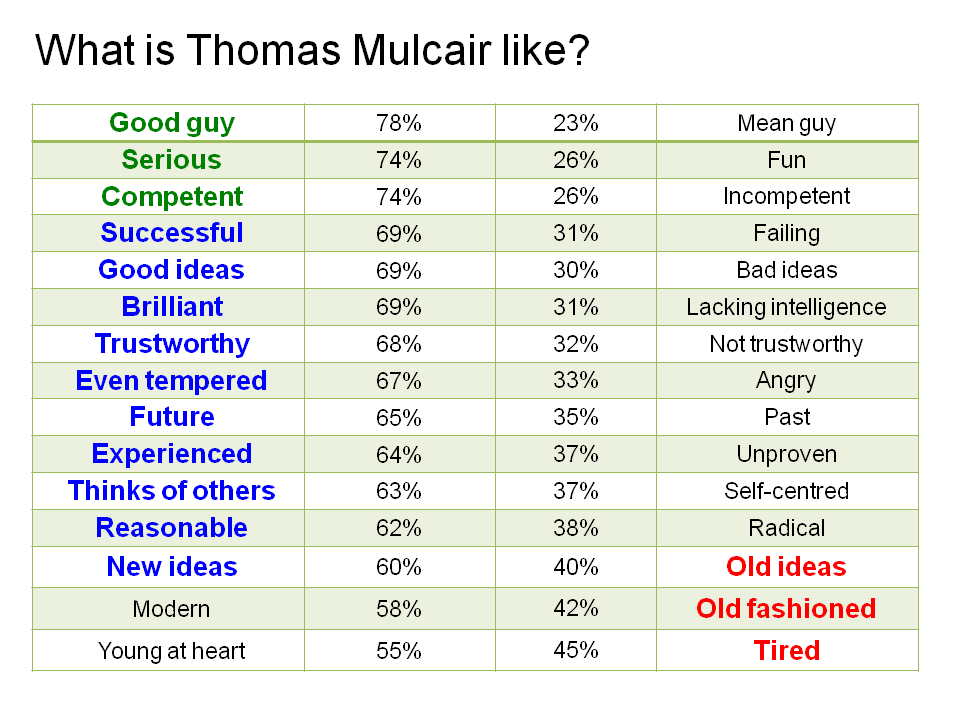
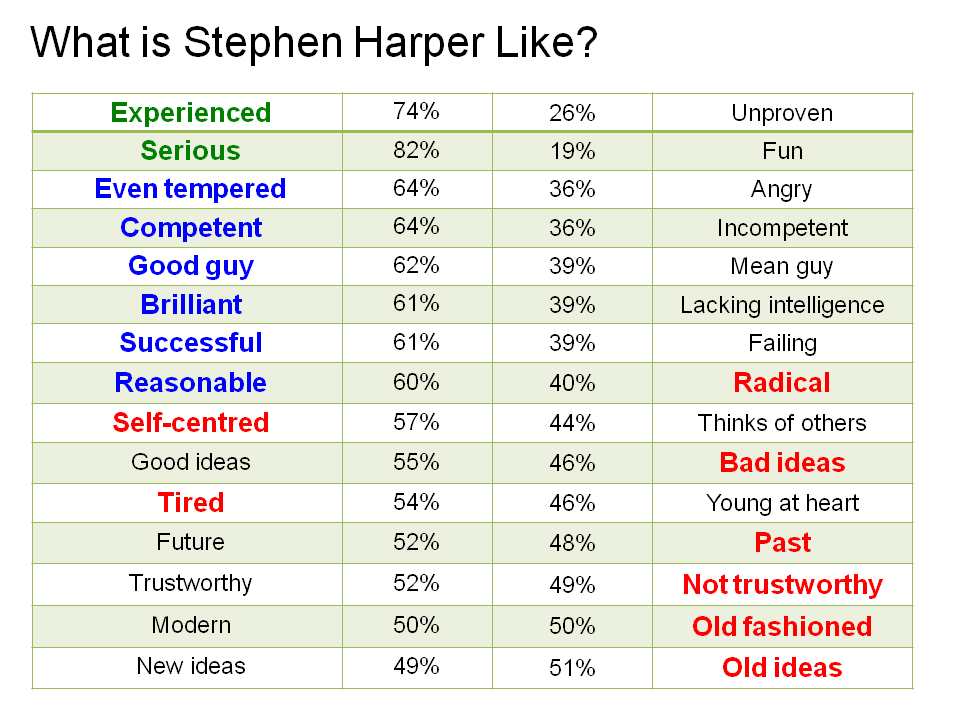
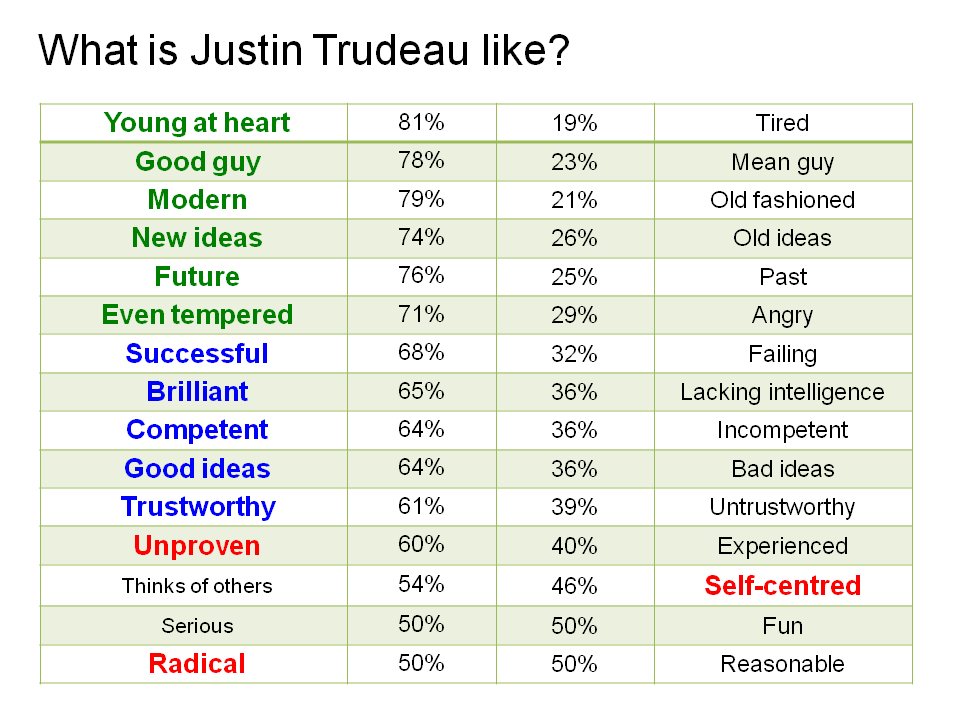
Our latest nationwide polling asked respondents to consider a series of choices of words or thoughts and asked which they most associated with three main party leaders. Our findings:
For Thomas Mulcair
His strongest attributes were: good guy, serious and competent. More than 70% associated these thoughts with the NDP leader. 60% or more also associated Mr. Mulcair with: successful, good ideas, brilliant (the other choice was “lacking intelligence”), trustworthy, even-tempered, future, experienced, thinks of others, reasonable (not “radical”) and new ideas. Areas of relative weakness (40% or more associated these with Mr. Mulcair): old ideas, tired, old fashioned.
For Stephen Harper
His strongest attributes were: experienced and serious. More than 70% associated these thoughts with the Conservative leader. 60% or more also associated Mr. Harper with: competent, even-tempered, good guy, successful, brilliant, and reasonable. Areas of relative weakness (40% or more): self-centered, tired, past (not future), not trustworthy, old fashioned, old ideas, bad ideas, and radical.
For Justin Trudeau
Mr. Trudeau’s strongest attributes were: young at heart, good guy, modern, new ideas, future, even tempered. More than 70% associated these with the Liberal leader. More than 60% also associated Mr. Trudeau with: successful, brilliant, competent, good ideas, trustworthy. Areas of relative weakness (40% or more associated these with Mr. Trudeau) are: unproven, radical, and self-centered. People were evenly divided on whether Mr. Trudeau was more serious, or more fun.
Another way to examine these numbers is to look at which leader is most closely associated with the attributes. Here is a selection:
Clearly, many people see positive attributes in each of the party leaders. The Prime Minister is seen serious, experienced and competent. He’s more likely seen as a good guy than a bad person, but his ideas are seen by some as more dated and controversial. He scores weakest on “thinking of others”. on questions of competence and brainpower, the PM is competitive, but does not lead the others.
Mr. Mulcair is generally quite well regarded by voters. His biggest advantage over the others are being seen as a good guy, competent and empathetic. His challenges are largely vis a vis Mr. Trudeau, compared to who he is seen as less contemporary. Despite the “angry Tom” critique sometimes heard, Canadians generally see him as even-tempered. He is not seen as particularly radical.
Mr. Trudeau is seen as someone who can bring a fresh, modern perspective to political leadership. He is seen as a likeable individual. He is seen as lacking in experience, but competitive when it comes to competence and brainpower. His biggest risk factors are that one in two wonder if his ideas may be radical, and the feeling that he has less experience than his competitors.
Methodology
Our survey was conducted online with 1,460 Canadians aged 18 and over from February 12 to February 16, 2015. A random sample of panelists was invited to complete the survey from a large representative panel of Canadians, recruited and managed by Research Now, one of the world’s leading provider of online research samples.
The Marketing Research and Intelligence Association policy limits statements about margins of sampling error for most online surveys. The margin of error for a comparable probability-based random sample of the same size is +/- 2.6%, 19 times out of 20. The data were weighted according to census data to ensure that the sample matched Canada’s population according to age, gender, educational attainment, and region. Totals may not add up to 100 due to rounding.
We offer global research capacity with a strong focus on customer service, attention to detail and value added insight. Our team combines the experience of our Chairman Bruce Anderson, one of Canada’s leading research executives for two decades, with the energy, creativity and research expertise of CEO David Coletto, PhD. For more information, visit our website at http://www.abacusdata.ca/
- See more at: http://abacusdata.ca/political-leaders-brands/#sthash.mCdsDXZn.dpuf
Stephen Harper's 'old-stock Canadians': Politics of division or simple slip?
Debate rages whether Tory leader's comment was 'dog whistle politics' or a chance remark
By Mark Gollom, CBC NewsPosted: Sep 19, 2015 5:00 AM ET Last Updated: Sep 19, 2015 6:42 AM ET
Stephen Harper has clarified his debate remarks, saying his 'old stock' comment referred tTo rephrase the popular Meghan Trainor song, when it comes to the Conservative campaign, the theory goes, it's always all about that base.
This is why EKOS pollster Frank Graves said that Harper's use of the term "old-stock Canadians" in Thursday's debate was a deliberate ploy to energize his supporters, part of the overall strategy to create a sense of us-versus-them.
Graves said it was the familiar "dog-whistle approach" — send out a message that will be ignored by all except its target audience.
But if that was Harper's intention, a kind of secret wink-wink to those in the Tory fold, then at least judging by the reaction, he blew a dog whistle of the wrong frequency.
During the debate, on the issue of immigration, Harper denied his government had taken away those health-care benefits from immigrants and legitimate refugees, saying that those who had been refused were bogus refugee claimants.
"We do not offer them a better health-care plan than the ordinary Canadian can receive," Harper said. "I think that's something that both new and existing and old-stock Canadians can agree with."
The "old-stock Canadians" remark, instead of going unnoticed, immediately unleashed an onslaught of questions over what "old stock" meant, whether it had racist overtones and whether it was part of an overall Conservative campaign to engage in identity politics or stoke fears against other groups.
'He wants to talk about the economy. He doesn't want to talk about whether or not he's a racist.'- Communications consultant Gerry Nicholls on Stephen Harper
Identity politics, or the politics of division, have been blamed for the Harper government's fight against allowing Zunera Ishaq, a Muslim woman, to wear a niqab while swearing the oath of citizenship. on Friday, the Conservatives refused to budge on the issue, saying the government would seek a stay of a Federal Court of Appeal decision that would have allowed Ishaq to wear the niqab while swearing the oath of citizenship.
'Random things happen'
Meanwhile, Harper has been accused of playing to fears of others and using security concerns as an excuse to keep Canada's doors shut to the plight of thousands of Syrian refugees.
"The fact that he is once again choosing to divide Canadians and to use fear in his politics simply isn't worthy of a prime minister of Canada," Liberal Leader Justin Trudeau on Friday.
NDP Leader Tom Mulcair also called Harper's comments "very divisive language."
"I think we're all Canadians and I don't like dividing people into categories like that," he said.
Harper accused of dividing Canadians2:03
Communications consultant Gerry Nicholls, who worked with Harper at the National Citizens Coalition, a conservative think-tank, suggested cheekily it's possible Harper's use of the "old stock" term was part of a secret plan, or that it was racist.
Or maybe, just maybe, he screwed up.
"People in politics think ... there's nothing done by chance, there's nothing random. It must be part of some of plan. Well, not always. Random things happen," Nicholls said.
"I don't think there was anything sinister to it beyond the fact that it was just something Harper said. Considering all the stuff that's going on, he's probably wishing he hadn't said it because, if nothing else, it's getting him off-message. He wants to talk about the economy. He doesn't want to talk about whether or not he's a racist."
On Friday, Harper was clarifying his debate remarks, saying his old-stock comment referred to "Canadians who have been the descendants of immigrants for one or more generations."
However, Nicholls said he does believe the Conservatives are mildly playing the "us vs. them" card with some of these issues.
But he thinks there's a disconnect with the media and how a significant number of Canadians feel about the niqab ban, or the Syrian refugee crisis.
For example, a recent EKOS poll suggested the country was relatively split on whether Canada was taking in too many or just about the right number of Syrian refugees. And polls taken during the niqab controversy revealed a large number of Canadians sided with the Tories.
"I think it plays well, not only with his base, but it cuts well, it resonates well, appeals to people who might be voting Liberal or NDP. Those kind of issues work well for Harper."
And as for the Conservative base, Nicholls said one issue is probably riling it up the most.
"If anything is energizing his base, it's the media, Liberal and NDP attacks on Harper."
With files from The Canadian Press
Harper claims on the economy not backed up by the numbers canadafactcheck.ca
Harper economy
A close look at the numbers reveals that Prime Minister Harper’s economic policies have been largely ineffectual and have contributed to a more polarized labour market.
Last Friday, Statistics Canada released its jobs report for July, 2015 – the first such release during the election period. Employment was up a bit in July as compared to June (+6,600) and the unemployment rate stayed at 6.8% for the sixth straight month.
Compared with a year earlier, employment had increased by 161,000 (or 0.9%), primarily because of the growth in full-time work.
Provincially, employment in ontario was virtually unchanged in July. Compared with 12 months earlier, employment in the province was up by 67,000 (+1.0%) and the unemployment rate fell 1.1 percentage points to 6.4%, the lowest rate since September 2008.
In contrast, in Alberta the unemployment rate increased by 0.3 percentage points to 6.0% in July. Since January of this year, the unemployment rate in the resource dependent province had increased by 1.5 percentage points.
Bottom line: not surprisingly, mainly due to the oil price collapse, central Canada is doing somewhat better than resource-based western Canada on the jobs front. But overall, the Canadian labour market remains sluggish and is performing at a far weaker level than its U. S. counterpart.
Stepping back from Friday’s July employment snapshot, it is worth examining exactly how the job market has performed under the Conservative government from 2006 to 2014. After all, the Harper government is touting its successful economic stewardship as the primary reason it should be re-elected. What does a close look at the 2006-14 jobs numbers reveal?
Let’s start off with the 5-year employment chart provided by Statistics Canada last Friday in its July jobs report.
Chart 1: Canadian Employment Growth
employment chartThe chart seems to suggest steady, if not spectacular, job growth over the past 5 years.
However, the first year of the five-year period portrayed in the chart is 2010 – a year or so after the economic collapse of 2008-9 with its huge job losses. one would assume a strong economic recovery would be in place in the first few years immediately following such a severe collapse so starting in 2010 probably doesn’t tell you much about the effectiveness of Conservative economic policies. Of much greater significance is what the jobs numbers look like when we go back to 2006 – the first year of the Harper government and a full two years before the onset of the recession triggered by the 2008 financial crisis.
So what does an anlysis based on the Statistics Canada numbers tell us when we start at the very beginning of Harper’s tenure?
First, the unemployment rate rose from 6.3% in 2006 to 8.3% in 2009, and then fell to 6.9% in 2014. In other words, despite the economic recovery, unemployment in 2014 was still significantly higher than in 2006.
Second, the employment rate (the percentage of persons who were working, as opposed to being unemployed or not actively seeking work) has fallen from 62.8% in 2006 to 61.4% in 2014, and did not increase in the recovery period from 2009 to 2014. This is mainly because many Canadians had stopped looking actively for work – most likely because they thought that no desirable jobs were available.
In terms of job quality, 32.2% of the total increase in jobs between 2006 and 2014 was in part-time jobs. This is a much higher proportion than the part-time share of the workforce in 2006, which stood at 18.2%.
Young People Hit Hard
An analysis done by economist Armine Yalnizyan suggests that young people have been particularly hard hit under the Harper regime. According to Yalnizyan:
“Between October 2008 and July 2009, young workers lost 185,000 full-time and 32,000 part-time jobs. Since then, they have recovered only 15,000 full-time jobs, though the number of part-time jobs is almost back to pre-recession levels. However, over the course of the past year, they lost 31,000 part-time jobs and added almost no new full-time jobs.
The primary source of employment for young workers has been in temporary forms of work (contract, seasonal, casual). Between 2008 and 2014, about half a million permanent jobs were added to the economy (466,000). In that time frame, workers aged 15-24 saw the loss of 181,000 permanent jobs.”
In other words, a close look at the jobs data under 8 years of Conservative government rule (and before the slowdown of the past six months) takes a good deal of the shine off of Harper’s lofty jobs claims. The long-term trend has been a shift towards a more polarized jobs market with the growth of low-pay and part-time work far out-stripping the growth of full-time work.
So the 2006 – 2014 jobs record isn’t all that the Harper government claims it is. But how much of this relatively lackluster performance can be blamed specifically on the Conservative government’s economic policies and how much on global economic forces beyond the government’s control?
The Conservative government’s signature economic policies: success or failure?
One way of assessing the Harper economic record is to select a small number of signature Conservative economic policies and assess the success or failure of each policy separately.
Three such Harper signature economic policies are particularly illustrative:
The reduction in corporate taxes; A conservative fiscal stance (austerity); and The priority placed on oil exports (i.e. Canada as an “energy superpower”). In the remainder of this post, we will look at the Harper record on corporate taxes. In a subsequent post, we will look at the government’s fiscal performance and its energy policies as well as Liberal and New Democratic Party proposals in all three areas.
Corporate tax cuts
Under the Harper government, the general federal Corporate Income Tax (CIT) rate has been cut from 22.1% in 2006 to 15% today. According to the Parliamentary Budget Office, the annual cost is about $12.5 billion in reduced tax revenues for the federal government.
The CIT now contributes just 13.4% of all federal revenues, down from 17.2% in 2007-08.
The Harper case for a significant cut in the CIT rate has always been that higher after-tax profits would increase corporate investment. But a close look at the numbers suggests that this just hasn’t happened.
First, business investment in machinery and equipment and in intellectual property combined, is below the 2006 level in real dollar terms – in fact has fallen from 7.2% to 6.2% of GDP.
Sluggish business investment is recognized by most economists to be one of Canada’s key economic problems, but the Conservative corporate tax cuts seem to have had little impact.
Why is this? The main reason for weak business investment – despite generally strong corporate profits and sky-rocketing cash reserves – is rooted in the weakness on the demand side of the economy. Businesses will invest only if they see strong and growing demand for their products and services – a situation that simply hasn’t existed in Canada in the past 9 years.
Another important factor is that Canada’s combined federal-provincial corporate tax rate is now around 26%, far lower than the 39% combined rate prevalent in the United States. In other words, corporate rates have been cut far more than was needed to give Canadian based companies a significant competitive advantage over U. S. based companies. In fact, in all likelihood, Canadian corporate tax rates were already more than competitive when Harper began his latest round of rate cuts.
Finally, a little known fact is that corporate tax cuts have resulted in an increase in revenues for the U.S. government since US companies operating in Canada get to deduct Canadian tax from their U.S. taxes.
Conclusion
The long-term trend under the Harper government has seen sluggish job growth combined with a shift towards a more polarized jobs market and the growth of low-pay and part-time work.
Corporate tax cuts have been central to the Harper government’s economic agenda from the beginning. The result has been a huge loss of public revenues for little economic gain. In other words, the evidence strongly suggests that this signature Conservative economic policy has been a failure.
In our next post, Canada Fact Check will look at the Conservative government’s other signature economic policies as well as economic planks being proposed by the two main opposition parties.
Prizefighter Trudeau proving a strong voice of a new generation
TORONTO — It was quite a night at the old Tin Can.
That is the name the doorman at the Intercontinental Hotel gave to the Roy Thomson Hall as I made my way to the best debate of a very lean season of good political theatre.
Hip, full of hop, and all showbiz, Justin Trudeau stole the show last night. It was billed as a foreign policy debate. It was really about politics as entertainment. The guy who isn’t supposed to be “ready” wasn’t quite Donald Trump, but he knew it was all about playing to the crowd.
It started with the arrival of his bus at the place Toronto’s mucky mucks gather to celebrate culture. While both the other leaders pulled up at the main entrance and quickly disappeared inside, Trudeau’s bus stopped 50 meters from the venerable front doors.
A cavalcade of acolytes poured out, Justin following closely behind. It had the feel of a heavyweight boxer making his way to the ring for the main event minus the hoodie and the shadow boxing. Sort of like Mick Jagger taking to the stage at the El Mocambo in another era. A rock star in the age of the rock star.
And Trudeau didn’t just walk to the entrance of the Tin Can as Stephen Harper did with his parked bus blaring out Taking Care of Business — a dubious choice of marching music for a guy trying to convince Canadians he is not the mouthpiece for the ‘1 per cent’. Trudeau waded into the crowd of supporters standing behind the ropes on the sidewalk with that big bear embrace that excites royal photographers. The money shot. The guy with the royal jelly embracing the great unwashed. Democracy.
Someone, maybe Trudeau’s guru Gerald Butts, had figured out the photo-op to perfection: Justin wading into a wall of adoring fans surrounded by a praetorian guard of campaign workers would get the TV shot of the night. Bingo. The cameras whirred. Producers pointed and shouted. The 15-minute news cycle had its red meat; it was the guy who TKO’d Sen. Patrick Brazeau — it was Rocky.
By the time Trudeau flashed that high-voltage smile and raised his arms going into the Tin Can, I was ready for anything. Minutes before, Kory Teneycke, who wishes daily that I have a blunt encounter with the business end of a Go-Train, had asked to have a picture taken with me.
Remember. This is Stephen Harper’s voice box, alter ego, dare I say it, evil twin. To the PMO, I am the great Satan of the war and bullshit. But never wanting to be the curmudgeon, I agreed. None other than CTV’s Bob Fife snapped the immortal shot – Cain and Abel smiling amicably for the camera before the fratricide. I suspect I will be pickled in a Tory attack ad, but hey, I have to admit, Kory has a killer smile.
You will read a lot of stories about the substance of the issues discussed but don’t be fooled. This whole event was an exercise in three men trying to snip off the family jewels of the others. The script was foreign policy, but the drama was all politics. Trudeau excelled by doing two things: showing passion and touching the emotional buttons usually the domain of Harper.
Example: The Liberal leader stole Harper’s family values turf by standing up for his famous father, who died exactly 15 years ago yesterday. Justin defended Pierre Trudeau from the attacks of the two other leaders with whom he shared the stage. He talked about his pride in being the son of such a man as Canada’s most famous prime minister — a stark contrast to the image of Pierre Trudeau offered by NDP leader Thomas Mulcair.
Several times during this entertainment, Mulcair linked Bill C-51 to the invocation of the War Measures Act. As Tommy Douglas had stood against the War Measures Act in 1970, Mulcair’s NDP was now standing up against Bill C-51 — unlike Justin Trudeau, he insisted.
You will never catch me doubting Thomas Mulcair’s brilliance or his principles or his party’s right to be seriously considered as a legitimate government for Canada. Too much talent in the party. But the audience seemed to care less about Mulcair’s accurate historical references to the War Measures Act than it did about a deeply felt nostalgia for the man who gave Canada the Charter of Rights and Freedoms.
open quote 761b1bMulcair was playing brilliant chess; Trudeau was engaged in a game of thrones.And if that left Muclair looking outdated, it left Harper coming across as a political dinosaur.
It turns out to be true. The beginning of wisdom is the suspension of judgement. Far more Canadians love Pierre Trudeau than hate him — at least the 3,000 or so who attended this event led me to believe.
Here is the irony. Mulcair, ever intelligent, blessed with a voice that could charm the pants off anything that has pants, and smarter than anyone in Canadian politics, looked a little old-fashioned in this contemporary gunfight at the OK Corral. There are new weapons in play these days – charm, charisma, and energy. In a word, Mulcair suffered from the defect of his best point; his calm, cerebral arguments were being directed against a younger man who is the incarnation of both generational and political change.
Mulcair was playing brilliant chess; Trudeau was engaged in a game of thrones.
And if that left Muclair looking outdated, it left Harper coming across as a political dinosaur. There is no doubt that the man who has ruled Canada for the last 10 years pleased his base. All the bases of the base were dutifully touched; war against the evil-doers, free trade as the panacea to everything, and the tried and untrue appeal to fear mongering. But it all looked a little tired last night, to the point that when Harper began extolling the virtues of his government’s approach to the environment, the audience actually snickered. No, more than that, they guffawed.
In the end, not much new came out of this debate. Harper offered the usual bromides that excite the right, complemented by absurd and opportunistic attempts to portray himself as a humanitarian and environmentalist.
Both progressive party leaders lamented Canada’s lost international reputation and urged a return to multilateralism and just plain soul. And no one touched the monster foreign policy issue of them all – the utter failure of the West to deal with the Assad regime while denoucing ISIS and making an ally out of an old enemy – al Qaeda.
When it was all over, I headed for the main entrance of the Tin Can. Across the street, two diligent aboriginals held up a sign about missing and murdered native women. As he left the building, they wanted Harper to see that not everyone present was obsessed with foreign affairs.
As for me, I hung around to hear the results of the Simcoe Street Poll, as the people filed out of the debate and offered their verdict in animated knots about what they had just witnessed.
No one was talking about Harper or Mulcair. They were all talking about Rocky.
—
Michael Harris is a writer, journalist, and documentary filmmaker. He was awarded a Doctor of Laws for his “unceasing pursuit of justice for the less fortunate among us.” His nine books include Justice Denied, Unholy Orders, Rare ambition, Lament for an Ocean, and Con Game. His work has sparked four commissions of inquiry, and three of his books have been made into movies. His new book on the Harper majority government, Party of one, is a number one best-seller.
Trudeau, Mulcair say Harper betraying Canada's reputation abroad 0
David Ljunggren and Randall Palmer, Reuters
Liberal leader Justin Trudeau (L-R), Conservative leader and Prime Minister Stephen Harper and New Democratic Party (NDP) leader Thomas Mulcair are pictured during the Munk leaders' debate on Canada's foreign policy in Toronto, Canada September 28, 2015. Canadians go to the polls in a federal el
OTTAWA - Canadian opposition leaders criticized Prime Minister Stephen Harper on Monday, saying he had betrayed the nation's reputation abroad by abandoning its commitment to multilateralism and helping those in trouble.
Justin Trudeau of the Liberals and Thomas Mulcair of the New Democrats - in a tight race with Harper's Conservatives ahead of an Oct. 19 election - said during a televised debate that Harper needed to take in many more refugees fleeing Syria.
Canada has said it would accept 23,000 Iraqi refugees and 11,300 Syrians but has been criticized for only resettling 2,300 Syrians to date.
Harper brushed aside calls for many more refugees to be allowed in quickly, saying they need to be carefully screened to ensure they do not pose a security threat.
"The entire world is looking at Canada and saying 'What is going on? You used to be a country that welcomed human beings, that appreciated diversity'," Trudeau said.
"That's what we were as a nation, and yet now Mr. Harper talks about nothing but security," he said to loud applause from the Toronto audience.
Harper said Canada was speeding up the process to take in those it has committed to accepting.
"We're living in an era where people are fleeing a terrorist war zone, and we obviously must have security screening," he said.
The Conservatives say they have taken the moral high ground in their nine years in power, shunning messy diplomatic compromises while resolutely backing allies such as Israel and Ukraine.
But many diplomats and Canadian experts say Ottawa has marginalized itself by a combination of extreme positions and miscalculations.
Shifting Canada's focus from peace-keeping to the military, Harper sent troops to Afghanistan and signed up for the mission against Islamic State, commitments warmly welcomed by allies such as Britain and the United States.
Canadian jets are bombing Islamic State targets and training Iraqi troops. The Liberals would bring home the warplanes while the New Democrats would scrap the entire mission, which was not sanctioned by the United Nations.
"Mr. Harper always takes the same approach ... when your only tool is a hammer, all problems resemble nails," said Mulcair.
Since taking office in 2006, Harper has distanced Canada from the United Nations, once the centerpiece of its diplomacy.
Under Harper, trade ties have also been uneven. His cool relationship with President Barack Obama and U.S. Ambassador to Canada Bruce Heyman have not helped Ottawa's attempts to persuade Washington to approve the Keystone XL pipeline, which would take Alberta oil to U.S. refineries.


 Các chuyên mục





 With 2015 federal election just over a year away, it’s clear that the Conservatives are panicking. They are unprepared for what appears to be a thorough shellacking by the opposition.